Showing posts with label library music. Show all posts

Wednesday, 2 September 2009

Brian Eno & David Byrne 'My Life In the Bush of Ghosts' (1981)


''My Life in the Bush of Ghosts
is a novel by African writer Amos Tutuola from Nigeria published in 1954. This novel recounts the fate of mortals who stray into the world of ghosts. The 'bush' is in the heart of the tropical forest, an impenetrable thicket left even after the rest of the forest is cleared for cultivation. Here, as every hunter and traveler knows, mortals venture at great peril, and it is here that a small boy is left alone.''

This album, from the very definition of a dynamic duo, is instantly recognisable as being in a genre all it's own, like 'Entroducing...' 25 years before the fact and accomplished not with samplers, but with simple manipulation of the raw tape; from Eno's recordings of radio call-in shows, evangelists, and the various Arabic samples that help to give the album it's haunting quality. Despite an underlying funkiness adeptly provided by Byrne playing most of the instruments (underrated musician that he be), this is a different beast to Byrne & Eno's work on the previous 3 Talking Heads albums.

The fascination with African polyrhythms remains, but as a listening experience it it free of associations with the oeuvre of either artist. The album takes on a life of it's own through the strange grooves characterized by found objects and African percussion, overlayed with those voices from disparate places in languages we can't understand - everything is out of context and the effect is supernatural and, like I said, unique. I've always loved this record and the only thing that comes close (despite all the claims of inspiration by other musicians down the years) is David Byrne's mostly-instrumental 1981 album 'the Catherine Wheel'. Innovative? Probably, 'My Life...' was obscenely ahead of it's time... but nobody went on to imitate the hands-on analogue sampling technique of this album (understandable given the headache it must have been without MIDI). Perhaps that's why sampled-based albums have rarely been so otherwordly? Having said that this would make good rush hour listening; it captures the cold and hollow functionality of an overpopulated urban area whilst being tethered to a sombre spiritual ancestry.

This is the 11-track CD edition (not the whopping 2006 reissue, but you are welcome to buy it for me =P), it's bloody marvellous and of course doesn't include the long-gone but fitting track 'Qu'ran'. The Islamic Council of Great Britain wasn't having a track that sampled readings of the Holy Book, and who were these two nerds to argue? It was struck from the running order, replaced with the B-side 'Very, Very Hungry' and has remained absent from all subsequent reissues. However you can hear it by clicking the link a couple of sentences back.

Here is the extremely cool official website of the album. The samples Eno originally used have all been made public domain so you can download them and do your own mixes. There are also streamable tracks and essays by Byrne about the production of the album and it's connection to the Tutuola book.
And for shits n' giggles here's David Byrne's web-o-log, which is surprisingly good reading... and he doesn't even have to upload any albums?!

Tuesday, 18 August 2009

BBC Radiophonic Workshop - Music From the BBC Radiophonic Workshop (2003)


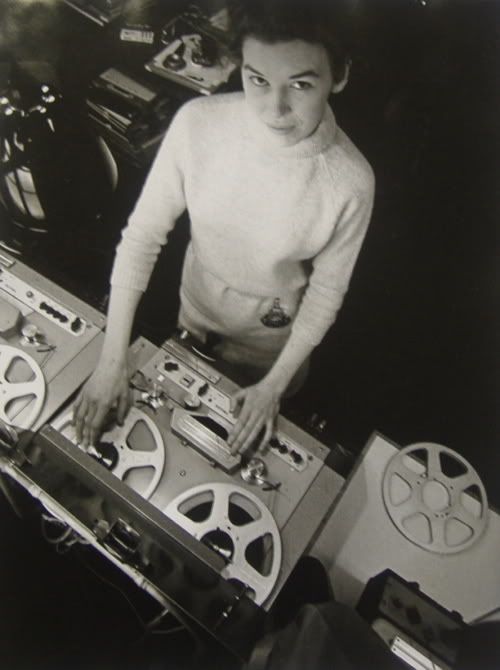
Having compared the subject of my previous post to electronic composer Delia Derbyshire on more than one occasion, I thought it would be good to follow through and let people know just who the hell I was talking about.

The late Ms. Derbyshire was first attached to the BBC's 'Radiophonic Workshop' in the early 60's, along with other drug-free young talent like Brian Hodgson and John Baker. The Workshop was a venture that, over four decades, became the BBC's very own in-house music and sound effects unit; producting for an extensive range of radio and television programming, as well as acting as an alternative to the expensive practive of music licensing.

From it's early days the Workshop was a hotbed for 'budget experimentation' that sought to make soundtracks and create a library of BBC sound effects, without having to hire orchestras and freelance composers. It was a coming together of maths/physics PhDs, BBC jobsworths and hundreds of miles of magnetic tape; the results were some of the most otherwordly and prescient electronic music of the twentieth century.

46 years on, the Workshop's biggest achievement in the public eye still remains the supremely weird proto-techno of the Doctor Who theme, and with good reason. It's hard to believe when you hear it, but this was made before the rise of polyphonic synthesizers (although oscillators are put to good use here); with Derbyshire actually taking Ron Grainer's original composition and realizing it in the manner that would become a signature of the Workshop - manipulating and splicing pieces of analogue tape by hand. The recordings being (literally) cutted & pasted were typically single tones made by instruments or, most commonly, 'found sounds' (bottles, bicycle wheels, anything goes). This approach must have been spurred on by the musique concrete avant-garde of the time... In the 60's at least, the Workshop very much reflects a playful spirit of the age, one that permeated everything from pop music to sound engineering.

The real genius of it though was in the twisted imagination of the music, and the skill these people must have had to build, layer upon layer, highly complex tracks: pulsating bass rhythms overlayed with effects, glitches and washes of sound rendered under such unique conditions as to actually seem extraterrestrial in origin... all with a mathematical precision necessitated by the clumsy, pre-sequencer technology. However the warmth of the analogue sound is more organic and personable; despite the arduous labour that went into making these tracks, generations of British electronica producers will testify that the Workshop was decades ahead of it's time, pre-dating the boom of cerebral, intricate electronica in the 1990's. Just listen to this unprecedented music and imagine - it was all handbuilt from scratch, not cobbled together through some unfathomably complicated monitor interface. At it's best, BBC Radiophonic Workshop was producing the most 'soulful' music you could derive from non-acoustic instruments (without the aid of samplers, which were a long way off).


This limited edition 10'' vinyl box set (compiled, appropriately enough, by Richard D. James' Rephlex label) covers the halcyon days of 1958-75; and by the 70's you can detect the advent of the Moog, also known as Delia's Bane. Not to fear though, because the bar is still set ridiculously high, and the likes of Paddy Kingsland would go on to do amazing work with the Hitchiker's Guide to the Galaxy (listenlistenlisten). Delia and John Baker both get their own discs, and the material runs from inspired bastardizations of radio (apparently a pig-headed British public drew the line at the Radio Sheffield theme); to forerunners for the soundtracks to hellish 80's science videos that some of you might remember from school (parodied perfectly here); to little TV-theme vignettes and beautiful, extended compositions not unlike Derbyshire/Hodgson's seminal electronic-psych masterpiece 'An Electric Storm'.
Mesmerizing, haunting and bloody weird... and it's all thanks to the British taxpayer!

Blue Veils + Golden Sands
Full track details
Comprehesive Delia-worship site