What: great soundsystem clash featuring Leeds' finest Iration Steppas versus Zion Train (London-based but initially formed in my old hometown of Oxford!)
What??: A disorientating blend of dub, dancehall, roots, ragga. Hiss is not bad, but if it bothers you lower the treble, and it goes without saying push the bass.
As it turns out, Zion Train are headlining the value-for-money Endorse-It-In-Dorset festival which takes place in one of the most beautiful country settings in England, if you are local and have never been I strongly suggest checking it out. (That's coming from somebody that abhors festivals with a passion). Also on the bill are my favourite unsigned pop experimentalists Henry's Phonograph, all their stuff is free to download and they 'get it', apparently.
^Click to enlarge. Awkard New Zealand 'zine interview
The third live album here, for you trainspotting Fallites. Recorded on the August, 1982 NZ leg in Auckland, Christchurch and Wellington respectively. Back when I posted Totale's Turns I claimed that it was the best Fall live album (by definition one of the greatest live albums ever), and 'Fall In A Hole' only narrowly fails to top it. But if TT, with it's dictaphone-in-the-audience, anti-punk recording quality, was too much for you to stomach, then you'll love the comparatively clear fidelity on this.
There's yet another 'best line-up ever' documented here, the almighty double-drumkit powerhouse of repute and myth, playing all the 'hits' from the sonic riot that is the Hex Enduction era. The remaster is excellent, with depth as well as volume to the sound, a whole disc of extra tracks which essentially just turn this into a double album, and I have included scans of the well-worth-reading Sanctuary liner notes.
'Fall In A Hole', which as you are listening might as well be one continuous wet-dream of a Fall set, positively crackles with malevolent garage oomph showcasing the band for what they were and still are 27 years later under Smith's guidance - a great live band. My credentials only extend to one gig at the Oxford Zodiac for the Fall Head Roll tour, but recent footage doesn't disappoint, they still play LOUD. I imagine one would have been similarly blown away by hearing the Monks in a dank German club in the mid-60's. But listen to this and just bear in mind: this is 1982, this is Culture Club, Bucks Fizz, the rise of 'popular capitalism' and buckets of yuppie wank. And here were a band commanding your attention with social-surrealist poetry barked over driving, post-industrial, Can-like anti-grooves played at 'ilevin', with all the conviction of a Group completely and utterly Alone. Brilliant.
Quite simply if you've ever read anything about the unfortunately-named and disparate 'Krautrock' movement of German experimental music, you will know how important this tome is. In fact, there's no way I'd be typing this if Julian Cope hadn't written his book, and you probably wouldn't be all-too aware of Can, Faust, Guru Guru, or the rest either... Who can say? But one thing's for certain - Cope's comprehensive guide to this late 60's/70's 'genre', first published in 1995 and still out-of-print (why, why, WHY?), revived interest in many of the pivotal groups to such an extent that sales were boosted and remasters issued - see the excellent Can albums on SACD (I don't know what they're for either, but they'z gold ).
As you probably know, despite mostly underwhelming sales, various Krautrock bands had an incalculable influence on young musicians the world over, on punk and beyond (Johnny Rotten insisted Tommy Vance play all 20-odd minutes of Can's Halleluwah when guesting on the fucking awful Capital FM), and nobody did more to bring this to the attention of a pre-Wikipedia public than Julian Cope. I didn't have my own computer until 2007, but it was constant mention of this book in music rag reviews and articles on the subject that kept my mouth watering at the prospect of ever actually reading the damned thing, laying eyes on the legendary 'Krautrocksampler Top 50'... Essentially, it lives up to all the hype. You are getting here, from the (sort of) printed word, what you can't get in bite-sized chunks from online encyclopedias: reams of detail in the accounts, the Druid's passion for the subject and what must have been many years worth of painstaking research. Not only that, but Julian Cope is beyond fantastic as a writer, and his enthusiasm comes across so fluently in his verbose rants and masterful anecdotes you will finish up convinced he is a genius. Check out the sublime Head Heritage site to see of what I speak.
One glance at the listening figures on Last.fm will show you that Krautrock is not only common property in the 21st century - it's actually popular ! And how could that possibly be a bad thing?
Here in two parts in .pdf form (you'll need this to read it), it's a bit harsh on the eyes trying to read a book from the monitor so be kind to them; unfortunately it's the best you'll get without forking out or learning German:
***Get sauer*** The credit for this is obviously not mine, I came across it many moons ago in a thread on the best general music forum there is, musicbanter.com. It seems to have been floating around on torrents for a while.
It's just as well Jules' solo career since the Teardrops has been extremely patchy, because he's excelled in all non-musical endeavours. Here's a fascinating, and periodically chuckle-worthy, televised version of his other highly-acclaimed scholarly work, 'the Modern Antiquarian':
A most intriguing artist/designer based in Bogota, with aspirations to relocate to Berlin. She works in ink and watercolours and there are some real beauties on the Flickr. Some great collage work, portraits and what (I think) is some nifty pattern design. If you are particularly taken, leave a comment! (I'm sure she would appreciate).
Apparently in the 80's some American people started a label as a launch pad for this thing called 'grunge' that sounds a bit like punk and a bit like metal, whilst not quite settling for either. I never understood all the hoo-hah myself... I lie of course, early grunge is a wondrous, marvellous thing, second only to a testosterone drip.
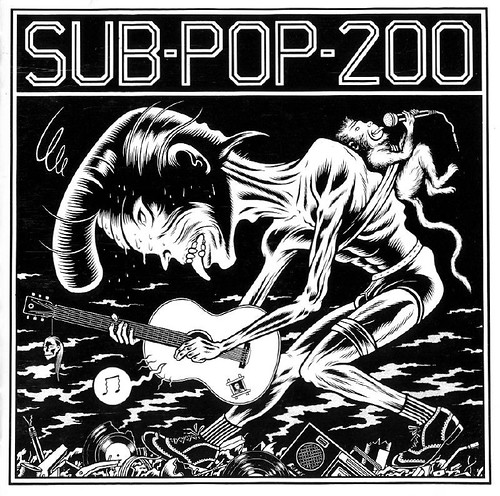
Sub Pop 200 is the second label sampler from, er, Sub Pop. Still one of the most successful independents to this day (one might argue that's down to major-label distribution deals but this is beside the point), the music may have broadened out a bit and calmed down for the most part, but there are still some great bands on their roster, the Flipper-meets-Jesus Lizard antics of Pissed Jeans being a favourite. Here's the list.
This compilation though, is a five-star snapshot of the times, capturing the nascent Seattle grunge scene when it was still a homegrown explosion of scuzzy distortion, tattered jeans and plaid. No international unit-shifters here in 1988, no copycat, watered-down nonsense, and a fair few surprises.
^ Great fat blokes in rock & roll - how many can you name?
For the most part you get hot and heavy, revved-up, slowed-down hardcore mixed with 70's hard rock theatrics; but look out for an acid-munching wall of FX from Screaming Trees, lo-fi college radio stalwarts Beat Happening with easily their least annoying song (a Suicide-esque dirge), the tedious spoken word of Steven J. Bernstein and the de-tuned home recording of the Thrown Ups (great track). The best thing about Sub Pop 200 though is not just the quality of the obscure bands, but also the total absence of sheen that would characterize the later albums of the more successful groups, bar the obvious exceptions. I guess in 1988 they were still young, filthy and hungry... that's certainly how it sounds. Oh, and almost all of these songs are exclusive to the compilation. Whatever happened to the fine tradition of the label sampler? Cracking semi-relevant article here.
So, Sub Pop 200 - yet another reason to thank our lucky stars that Black Flag decided to grow their hair...?
''Nehemiah Skip James was born in 1902, and raised on the Woodbine Plantation near Bentonia, Mississippi. He became interested in music around 1909, after hearing Green McCloud playing Drunken Spree on the fiddle, backed by guitarists Henry Stuckey and Rich Griffith. After World War 1, Stuckey and James, together with Jack Owens, developed the Bentonia style. In France, Stuckey had learned an open E minor tuning from some black soldiers (who he believed were Bahamians), and this tuning, picked with three fingers in complex patterns, became the basis of the guitar pieces Skip was to record in 1931. Only Drunken Spree, pattern picked in A, and Special Rider Blues, in open G, are exceptions, and for all its charm, there is a great gulf between Drunken Spree, basically a vocal tune plus accompaniment, and the tightly knit pieces, for voice and guitar are equal expressive partners, that James composed in the new style. In the early 20's, he took up a hobo's life, meeting a whorehouse piano player named Will Crabtree in Arkansas, learning a good deal of piano technique from him. In 1931, James auditioned for H.C. Speir, Paramount's Mississippi talent scout, and was despatched to Grafton, Wisconsin on a two year contract which he hoped would eventually free him from manual work. (Paramount shortly went broke during the Depression, and Hard Time Killin' Floor Blues, composed at the session, became personal as well as topical).
Seldom can there be seen a more impressive start to a recording career than Devil Got My Woman, a seamless pattern of counter-tenor voice and eerie, hollow guitar, each taking up and embellishing the other, to form perhaps the single most poignant blues about failed relationships between men and women. On Devil, as on most of his songs, James achieved an unrivalled unity between the content of the words and the sounds of the music to which they are set. The generally dour, pessimistic mood was at one with James' own misanthropic philosophy; even the spirituals don't seem very consolatory, and the blues seem intended rather to display and justify James' anger and sorrow than to provide a purgation of them. His guitar playing, always remarkable, reaches a summit of musicianship on I'm So Glad, a lyrically insignificant song used as the basis for a display of sensationally fast and accurate fingerpicking; his thumbwork on the bass strings is especially noteworthy.''
^ I chose this as it will probably be his most familiar tune today, ever since it's appearance on a certain Coen brothers film, the popular soundtrack to which revived public interest in bluegrass .
''Just as sensational and even more individual, is James' piano playing which is like no other on record. Staccato and percussive, it functions, like his guitar work, as a response to and elaboration of his vocal lines. Sometimes he contributes additional percussion by stomping on a board placed in front of the piano; the frequent independence of this rhythm from that laid down on the keys will repay attention, and is another indication of James' mastery, alike of musical ideas and their execution. 22-20 Blues, made up in the studio, contains one of the most remarkable piano breaks in blues, with spectacular glissandi, and his transformation of Leroy Carr's How Long How Long into a manic buckdance is almost as extraordinary.
It's not surprising that a musician as individual as Skip James had little stylistic influence on others. Robert Johnson increased the 22-20s calibre to 32-20, and Johnny Temple and Joe McCoy also made covers of songs by him; but their versions owe little to the originals beyond the words. Skip James was simply too much of an individual, too much of a genius, to be easily copied. Relocated in the 60's after years of preaching, strip mining and farmwork, he made a short comeback, dying in 1969. He still retained much of his talent, and all of his suspicion, both of the rest of mankind and of what he called the 'music racket'; but he never equalled the astonishing performances he had recorded in 1931.''
Now and again 1979's 'Metal Box' resurfaces from the murky depths of a Mariana trench that is permanently etched into my psyche. It was always an obsession but I don't think this trench was dug until the day I played the album on a pair of hand-me-down standing speakers, a bargain from my flatmate, and first cautiously turned up the bass dial on the amplifier. It was the same dial that brought roots and dub to life via the Trojan Dub Box and Super Ape.
This is all the more significant since honourary rasta John Lydon met many of the artists on those records himself on his infamous trip to Jamaica, before returning to record the first two PiL albums. I have a recollection of an anecdote from the Lydon autobiography, essentially recounting how he and the great Don Letts went to an authentic soundsystem dance in a rough part of Kingston. Within a few tokes of powerful Jamaican skunk these Eastenders were unaccustomed to, they fell unconscious under a palm tree, carried on the sub-bass. They awoke to find the performers, the crowd and all the equipment gone! For some reason it's a powerful and soothing image, whenever I recall it it's as if I were there myself...
It's 'Metal Box' though that takes the dub template to new spaces and fuses it with experimental German rhythms, among other things. I will post it someday, hopefully when it is remastered, because in many ways it's my favourite record. 'Poptones' is about a kidnapping/murder, I am guessing.
Drive to the forest in a Japanese car The smell of rubber on country tar Hindsight does me no good Standing naked in this back of the woods The cassette played Poptones Can't forget the impression you made Left a hole in the back of my head I don't like hiding in this foliage and peat It's wet and I'm losing my body heat The cassette played poptones. Miss bleeding heart Looking for bodies Nearly injured my pride Praise picnicking in the British countryside.