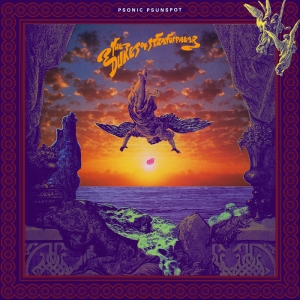
Originally compiled for my friend Trix; a spiritual sequel to my 2007 'Teatime Psychotropics' compilation of transatlantic 1960s psychedelic pop. A few non-UK/US groups. Mostly obscurities. Goes from the baroque and whimsical to more garage rock-y in the second half. Contains the best cover of Tomorrow’s ‘Real Life Permanent Dream’ you will ever hear. Non-aficionados of the era should probably steer clear and listen to fucking Deerhunter or something.
1.Scarecrow’s Love Affair - Blues Magoos 2.Time Track - Skip Bifferty 3.Life Is Short - Billy Nicholls 4.What Does It Feel - The End 5.When The Alarm Clock Rings - Blossom Toes 6.The Birthday - The Idle Race 7.Yo Recuerdo Mi Mundo - Los Shakers 8.14 Hour Technicolour Dream - The Syn 9.Wake Up Cherylina - The Smoke 10.Real Life Permanent Dream - Orange Machine 11.Starvation - The Golden Dawn 12.Feathered Fish - The Sons Of Adam 13.The Letter - The Mops 14.Changing The Colors Of Life - Los Chijuas 15.All Night Stand - The Thoughts 16.99th Floor - The Moving Sidewalks
A cottage industry that was churning out 110 Top Ten hits like nobody's business between 1961 and 1971; whose productions possess a timeless-yet-nostalgic quality that reduces music snobs and casuals alike to a quivering heap; that was Motor City's largest export after automobiles (and certainly the more culturally significant); to which generations of musicians and songwriters are indebted; the soul/R&B Mecca-Eden and the driving force behind the Northern Soul 'pre-rave' phenomenon in the UK... What pop music witchcraft is this? That's a question which I as a lowly music fan am not qualified to answer, but here's a succinct passage poached from that ever-questionable academic resource the Wikipaedos:
Motown’s music was crafted with an ear towards pop appeal. The company specialized in a type of soul music it referred to with the trademark "The Motown Sound". The Motown Sound was typified by a number of characteristics: the use of tambourines to accent the back beat, prominent and often melodic electric bass guitar lines, distinctive melodic and chord structures, and a call and response singing style that originated in gospel music. In addition, pop production techniques such as the use of orchestral string sections, charted horn sections, and carefully arranged background vocals were also used. Complex arrangements and elaborate, melismatic vocal riffswere avoided; Motown producers believed steadfastly in the ''KISS principle'' ("keep it simple, stupid").Read the rest as you listen, fascinating stuff!
Great, but it doesn't satisfy my affinity for pointless comparative analysis... Ever seen a classic Martin Scorsese movie, noticed his tendency to big, upbeat orchestral soul? That's one aspect of Motown Records. In fact even in the incredibly unlikely case that you've never even heard of Motown, you will definitely have come across at least one of the songs included here during your lifetime; it will take a cattle prod to the withered memory bits o' your brain - as if you're revisiting a long-forgotten childhood... via the gift of ECT.
It's just that 60s magic to some extent, that is: the clean-but-not-over-processed-to-tawdry-shit analogue production, the guitar sound, the characteristic effects and instruments of the era; but it's also the Motown THING. Is it in-house session musician icons the Funk Brothers, the stock songwriting teams (which included flagship singers like Gaye, Robinson and Wonder)?; or is it simply the perfect combination of time, place, passion and inspiration? Probably... What do I know.
So, not to be missed. Should you even consider yourself something of an expert on the classic single-oriented era of Motown, this'll still knock you for six - 38 tracks! But it goes by in a flash, there is plenty of space for the less familiar stuff and each song retains an unmistakable identity. Despite the classic Motown remit outlined above there is considerable variety - check out the gritty, psychedelic garage stomper below!... The total euphoric effect of all this is something like a whirlwind. They truly had pop music down to a science.
...But there's one catch which I have to apologise for. I acquired this in 2007, and it served as my official introduction to a bedrock of popular culture that had somehow been omitted from my upbringing. Unfortunately the mp3s are in 128kbps. I've scoured the blogosphere and online retailers, but nothing matches the title... this first-class delight of a compilation is likely some blogger's one-off. To some people this won't make a difference, but to the rest of you I would still implore you to take the dive. On the plus side, the occasional dodgy high-ends in the sound neatly replicate the experience of listening to the songs through a transistor radio on the kitchen table in 1966, or dusty old vinyl. If you can find a collection on a par with this in better quality... you are a better man than I, and you should share the wealth in the comments box forthwith. cheers, J x
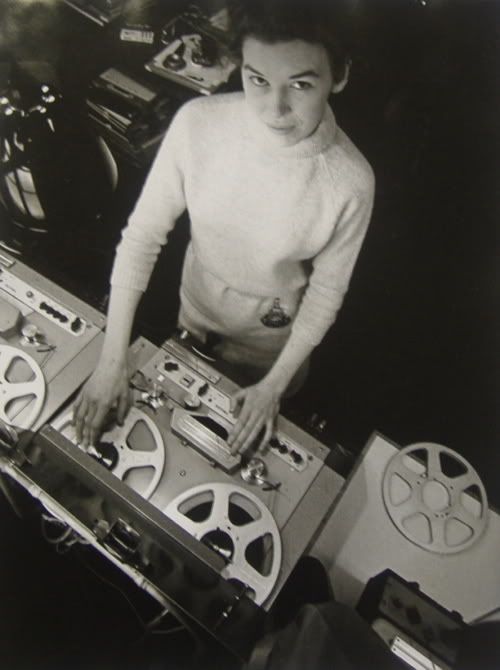
Having compared the subject of my previous post to electronic composer Delia Derbyshire on more than one occasion, I thought it would be good to follow through and let people know just who the hell I was talking about.
The late Ms. Derbyshire was first attached to the BBC's 'Radiophonic Workshop' in the early 60's, along with other drug-free young talent like Brian Hodgson and John Baker. The Workshop was a venture that, over four decades, became the BBC's very own in-house music and sound effects unit; producting for an extensive range of radio and television programming, as well as acting as an alternative to the expensive practive of music licensing.
From it's early days the Workshop was a hotbed for 'budget experimentation' that sought to make soundtracks and create a library of BBC sound effects, without having to hire orchestras and freelance composers. It was a coming together of maths/physics PhDs, BBC jobsworths and hundreds of miles of magnetic tape; the results were some of the most otherwordly and prescient electronic music of the twentieth century.
46 years on, the Workshop's biggest achievement in the public eye still remains the supremely weird proto-techno of the Doctor Who theme, and with good reason. It's hard to believe when you hear it, but this was made before the rise of polyphonic synthesizers (although oscillators are put to good use here); with Derbyshire actually taking Ron Grainer's original composition and realizing it in the manner that would become a signature of the Workshop - manipulating and splicing pieces of analogue tape by hand. The recordings being (literally) cutted & pasted were typically single tones made by instruments or, most commonly, 'found sounds' (bottles, bicycle wheels, anything goes). This approach must have been spurred on by the musique concrete avant-garde of the time... In the 60's at least, the Workshop very much reflects a playful spirit of the age, one that permeated everything from pop music to sound engineering.
The real genius of it though was in the twisted imagination of the music, and the skill these people must have had to build, layer upon layer, highly complex tracks: pulsating bass rhythms overlayed with effects, glitches and washes of sound rendered under such unique conditions as to actually seem extraterrestrial in origin... all with a mathematical precision necessitated by the clumsy, pre-sequencer technology. However the warmth of the analogue sound is more organic and personable; despite the arduous labour that went into making these tracks, generations of British electronica producers will testify that the Workshop was decades ahead of it's time, pre-dating the boom of cerebral, intricate electronica in the 1990's. Just listen to this unprecedented music and imagine - it was all handbuilt from scratch, not cobbled together through some unfathomably complicated monitor interface. At it's best, BBC Radiophonic Workshop was producing the most 'soulful' music you could derive from non-acoustic instruments (without the aid of samplers, which were a long way off).
This limited edition 10'' vinyl box set (compiled, appropriately enough, by Richard D. James' Rephlex label) covers the halcyon days of 1958-75; and by the 70's you can detect the advent of the Moog, also known as Delia's Bane. Not to fear though, because the bar is still set ridiculously high, and the likes of Paddy Kingsland would go on to do amazing work with the Hitchiker's Guide to the Galaxy (listenlistenlisten). Delia and John Baker both get their own discs, and the material runs from inspired bastardizations of radio (apparently a pig-headed British public drew the line at the Radio Sheffield theme); to forerunners for the soundtracks to hellish 80's science videos that some of you might remember from school (parodied perfectly here); to little TV-theme vignettes and beautiful, extended compositions not unlike Derbyshire/Hodgson's seminal electronic-psych masterpiece 'An Electric Storm'. Mesmerizing, haunting and bloody weird... and it's all thanks to the British taxpayer!
A snappy little two-album anthology of the ultimate psychedelic nostalgia here, as performed by Sir John Johns and his merry band of toytown travellers - better known as New Wave songwriting geniuses XTC.
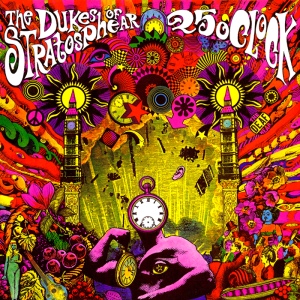
The neo-psychedelia tag is a misnomer really, seeing as the Dukes of Stratosphear's output was that of a loving tribute to the anni mirabiles of 1967 and 1968; no doubt the fruits of swollen record collections and weed-fuelled in-joking. Partridge & co's moment of indulgence is in fact so complete that were it not for the slight giveaway of John Leckie at the boards, one could be fooled in to believing the Dukes were a great obscure band of the psychedelic era, and no doubt this was their intention. Fans of that fertile period of ambitious songwriters will absolutely lap up this little experiment; it comes out as a seamless amalgam of all your favourite 60's drug music, at times sounding exactly like a lost Beatles album from between 'Sgt. Pepper's' and 'Magical Mystery Tour', at
others recalling the frenetic paranoia of the Pretty Things, or staples like Tomorrow and Art. The 1985 mini-album '25 O'Clock' is perfection and the '87 full-length 'Psonic Sunspot' literally has nothing wrong with it either - the only downside I can see is if you aren't all that fond of 60's psych, but then why the hell are you even breathing? Andy Partridge demonstrates a great ability throughout to mimic the clichéd effects and studio trickery of the era, whilst utilising his characteristic songwriting ability to keep things awesome. He has plenty of fun with the lyrics of course, the late 60's being one of the most ripe-for-parody in the history of pop. Special mention must go to 'Bike Ride to the Moon', which is like a tongue-in-cheek version of 'My White Bicycle': Why not bring a pot of tea / On a bike ride to the moon? / Angel cake for you and me / On a bike ride to the moon. What's not to like?
Within this multi-coloured tea chest lie nestled some of the best songs XTC recorded in the studio-only part of their career, in my redundant opinion. In short, I be your witch doctor and 'Chips From the Chocolate Fireball' is what I prescribes.
The Move. The Move, the Move, the Move. They were chart staples at one time, NME Poll Winners, and are clearly some sort of perfect cross-pollination of the Beatles, the Kinks and the Stones, yet how often do you hear them name-dropped these days? Not often. For shame, for shame, for shame. Not only do they contain elements of all those bands, throughout their existence moving from epic psychedelic pop to garage rock, but they were mixed better, with a more dyamic range than the tinniness/saturated warmth of the Four-Headed Monster. It certainly helps that this relatively recent and near-flawless compilation is all remastered.
60's eccentric auteur Roy Wood heads up proceedings. His former band the Idle Race(which also featured Jeff Lynne, who would join the Move in 1970 and with Wood later formed Electric Light Orchestra) are one of my faves, but like this band they start to lose my attention towards the end of their existence. This could be one of several things, it could be the move (HAHA) into mediocre hard rock territory, but it's more likely the departure of their first singer Carl Wayne, for whom I have a soft spot. And also the ouevre of Jeff Lynne irritates me slightly. Whatever. This compilation, however, is basically wall-to-wall greatness, and the music doesn't have the 'slighty dated symphonic-poodle disco nightmare' factor of ELO, which for me is a distinct boon. Let's just say the Move were cooler. I mean just WATCH.
^Ever felt socially alienated by your acid vizhunz? The Move have.And Carl thinks he's Elvis.
That is certainly their most covered song, but why aren't they more universally adored? Is it because they're from Birmingham? Huh?
Ladies and gentlemen, here is the ultimate radio bonanaza for the discerning 60's connoisseur; no matter how much you think you know you will learn something here. Psychedelia, garage bands, girl groups, beat, mod R&B, folk and blues - the whole bit.
The show is broadcast from Stockport, Cheshire (that's north west UK) and presented by the Mancunian Candidate aka Ben, in a highly endearing Mancunian brogue. He calls his listeners cellar dwellers and it's presented in a great no-frills, old skool British radio stylee. Just passion for music and light-hearted musical entertainment... I suspect Ben is spiritually not of this decade.
I was tuned out for a while but I returned to the show to discover Ben's aptitude for securing the most amazing and unlikely interviewees, including Gary Burger of the Monks. I'm posting this here because tomorrow he is interviewing Peter Daltrey from one of my favourite 60's groups - KALEIDOSCOPE. Need I say more?
The Cellar Tapes SATURDAYS
1pm - Los Angeles 4pm - New York 9pm - UK 10pm - Berlin
TUESDAYS (repeat)
12pm - Los Angeles 3pm - New York 8pm - UK 9pm - Berlin
Hugo Fattoruso - guitar/piano/harmonica/vocals Osvaldo Fattoruso - guitar/vocals Roberto 'Pelín' Capobianco - bass/backing vocals Carlos 'Caio' Vila - drums/backing vocals
Do yourself a favour and download this now, and listen while you read. Because this is a good one, a real diamond in the rough that was 60's international beat pop. By this I mean that, regrettably, there were very few non-Western groups of the the era that weren't direct cash-ins on Beatlemania, or the worldwide popularity of the Stones and the Kinks. Everything was carbon-copied from the 'four-headed monster' template: the haircuts, the songs (normally just making minor alterations to the chord sequences of the latest hit, if not just simply releasing no-frills cover versions), the teen exploitation movies, the 'cheeky' parent-baiting personalities... It doesn't sound too promising so far does it?
Similar to the Japanese 'Group Sounds' wave of commercial pop, South American groups were dragging the early 60's beat template well into the latter part of the decade, long after the fickle trendsetters in the US and UK had moved on. The band being presented here, Los Shakers, played rowdy beat pop and were modelled after the Fab Four, while their 'rivals' Los Mockers were Stones clones. That's not to say there weren't great original songs being produced in the region, or even a few classics albums (that I'm aware of), the most infamous example being Brazil's Os Mutantes. What made that album so great was the reappropriation of epic, psychedelic chamber pop with traditional music styles, making it a Sgt. Pepper's-inspired album that sounds totally Brazilian (this individuality, of course, earned them only the ire of the government).
^ This is Los Shakers' biggest garage-like hit from the 'Invasion' era, and the best example of their lasting legacy in 60's Latin beat... 'La Conferencia' doesn't sound like this, but I love this track as it lives up to their one-dimensional name.
So that's all very well, but in 1967 Los Shakers had also been listening to this Sgt. Pepper's, and like everyone else must have realised that things would never be the same again. This revolution came from the band that was their bread and butter, the very reason for their existence. They had to move on. By this time the Shakers had made their mark as leaders of the 'Uruguaryan Invasion' (which for some reason was mainly an Argentine phenomenon); and like the Monkees in America, they were a talented band on a commercial leash who were beginning to get itchy feet. The 1968 loose-concept extravaganza 'La Conferencia Secreta Del Toto's Bar' is the result. This is a ridiculously good high-pop album and a criminally overlooked world contender. Not only is it all the more respectable for incorporating Latin candombe and tango styles into the mix (yet still sung in English), but it's a huge leap from the restrictive beat formula they stuck to previously. Predictably, the EMI label execs couldn't see past their pay cheques, and dropped Los Shakers for not producing an LP of 3-minute hits. I'm sure if Los Shakers had stuck it out and waited for the Argentinian market to catch up, this might have been better received. Unfortunately it was not to be and this was their last album-proper.
It's all a bit mystifying, especially as to the modern listener every song on 'the Secret Conference of Toto's Bar' is instantly catchy. Sure, the first half of track one has a vocal line that sound uncomfortably like 'I Am the Walrus', but that's where the Beatles-hijacking of old ends. It may not be startlingly original, it may be sung in broken (but charming and comprehensible) English, and it may also be in the same symphonic ballpark as Sgt. Pepper's and Pet Sounds; but the songs more than speak for themselves and some real classics come to light. The band is easily as tight as those Other Guys, their harmonies are up their with the Wilson brigade, and their songwriting and composition skills didn't seem to suffer from a career languishing in pastiche. In fact, you'd swear they had been secretly practising for this moment all along...
Una descargar muy especial, incluyendo obras de arte!* @320kbps, remaster with (good) extra tracks UnoDos
*disclaimer: I don't speak Spanish. Please correct me.
Recycled from an old MeineSpace post, this needs sharing. I'm not the only person to post it but if it helps them get more listeners on Last.fm then what the hell...
Here we have an album that at it's worst is a historical curio and a comedy album; at it's best a world-class garage romp.
The Mops were, from what I've heard, the rawest and weirdest of Japan's sanitized 'Group Sounds' era. Group Sounds was a fusion of Western rock and Japanese popular music - which for the most part was melodramatic tripe and pretty much all manufactured, with creative control going to the record executives.
As with most Group Sounds bands they began as a Ventures-esque instrumental rock group, before taking on the mantle of drug-influenced blues and rock music emanating from overseas to become Japan's first bona fide psychedelic band. This was not the idea of the Yardbirds/Stones influenced group of course, it was the Mops' management who molded them into hippies as stipulated in their new record contract (see album cover).
However LSD was impossible to procure in Japan at the time and as well as putting on the most dazzling light shows to cement their psychedelic credentials (the other Group Sounds were catching on fast), the Mops would often play blindfolded to disorientate themselves.
So as well as being trippy dippy and lyrically darker than any Group Sounds band at the time ('please kill me' in the 6/8 time 'Blind Bird'), what does this alien interpretation of 60's vogue have to offer?
For a start I was struck by the garage influence, there's a lot of fuzzboxed guitar and it certainly packs a wallop; and when the Mops are in full swing (playing their own songs) the vibe is great too: Masaru Hoshi's perpetual, trebled guitar solos coming from somewhere off in space and the band keeping a frenetic groove under some brilliant freewheeling blues-psych.
^ Vintage pop cameo. Dig those ponchos!
All sounds good so far, non? But now I have to address the infamous cover versions of psych standards and the all-English vocals.
When the Mops are attacking these songs in their extremely bloken Engrish and their own inimitable style, it can work ('Somebody To Love' sounds great, singer/guitarist Yoshiro Hayakawa must have spent days getting the 'L' on 'love'); but the rest of the time you just can't help but giggle, and there are certainly a few comedy moments on the album such as the adorable ode 'San Franciscan Night'.
There is an element of humour when listening to this strange record, being as it is a heartfelt tribute to/cash-in on a Western pop culture... just totally naive and a lot of fun. None of this would matter if the songs weren't great. On the whole it's magnificently done, they manage to work in everything from harpsichords to a Misunderstood-style sense of doom - but there are some flaws. See: the inept sitar racket of 'Unforgettable Memory' and the musically competent but slightly comical covers of 'White Rabbit' and 'Light My Fire'. The pros far outweigh the cons though and it definitely belongs in your 60's collection.
Unfortunately when the album surfaced, Group Sounds was on it's last legs - Black Sabbath and Led Zeppelin were beginning to catch the attention of Japanese youth... The Mops were dropped =(
And this is where we leave our (magnificently named) heroes, who would cunningly move with the times and re-brand themselves 'New Rock'. It was left up to other, hairier bands to make history in this area...
Sources: Cope, Julian, 2007. Japrocksampler: How The Post-War Japanese Blew Their Minds On Rock 'n' Roll. 1st ed. London: Bloomsbury
Thirty-two jolly good reasons to love the Kinks, in their pomp: A-D E-R S-Z
Fine young dandies led by eternal pessimist and English storyteller Ray Davies. Davies steered them and their music away from the vapid celebrity of Carnaby Street and the hippies of Hyde Park; straight into dreamlike, parochial visions of a peaceful life in the countryside and a post-war England fast losing it's identity (whilst rocking the balls off many contemporaries).
Having lost a media-contrived 'battle' was with the Beatles, record sales plummeted and the Kinks never hit their 60's peak again, bar the odd hit.
The 'Village Green Preservation Society' however, lived on through Blur in 'Modern Life Is Rubbish'. One of the most affecting indie albums of the 90's which mourned the state of an Americanized, 'Chemical World' in which everything (except the rent)is cheap. Record of the decade.
If Blur thought they had it bad, pastoral dreamers the Young Knives may as well be fighting a lost cause... But they try, bless them. The Knives have been written off as new-wave suits despite being one of the few to swim against the unrelenting tide of bullshit from our Great Capital.
But don't worry - as long as we have all the online validation and instant ecstasy we can cram into our eyes sockets, nothing useful will get in the way of the photo albums depicting our budding alcoholism and 'wild' toga/school uniform parties on Facebook. Drink up, Johnny.