Right, a bit of a break from the norm here as this is not an album share; but I've included a few streams for you to peruse whilst you deliberate on taking the monumental risk of actually paying FIVE POUNDS for an excellent record by a lovely person whom, in all certainty, deserves the money.
Powdered Cows is the solo alias of multi-instrumentalist songwriter Martin Roberts, resident of the rolling hills and sweaty crevices of Dorset (this is an important factor as we shall find out).
Compared to the playful noise-jazz chaos of one of Martin's many group projects, Skitanja, the Powdered Cows output is predominantly of the introverted, reflective indie-folk variety. I'm crap at hearing lyrics, but based on the artwork and song titles this album is inspired by very late nights and the 'blissed-out' (as a friend recently put it) atmosphere of the countryside in the South West. It's my belief that the closer to nature you are, the closer you are to the essence of life, and this is reflected in the Powdered Cows listening experience, which is quite ethereal. 'Descent From Animals'.
From track to track the permeating sound is hushed and reverential, even when things take a darker turn it's as if Martin were staked out at 3am with Bill Oddie, waiting for a badger to emerge from its burrow. These references to nature shouldn't be misread as New Age philosophy either - think more along the lines of British Sea Power, a pastoral Englishness and celebration of peaceful life, with a dash of spirituality.
A lot of work has gone into the production, and each track is layered with instruments, synths and samples of all kinds: woodwind, strings, trumpet, drum machine, accordion, toybox, to name but a few. It's the sound of a musical collector bringing his toys out of the loft to play. But what really ties this record together for me are the sound samples and the hissy gramophone-like effect on many of the tracks. We hear birds crowing, what sounds like pattering rain throughout 'Eyes of Knives', radio static, a kick-drum that almost recreates the sound of a record skipping on 'Little Red Lilly Beetle', and a denouement that, appropriately, reminds one of the 'Lonely Man' theme...
Every song is legitimately catchy, but it's easy to overlook this amidst the homespun, secretive ambience of the album, which is only punctuated in the first half by Angus Rudd's driving drumwork featured on such tracks as 'Hidden Tapes'. This actually rocks in a subdued, post-punk way and is one of my favourites on here; with an intro that sounds like a processed organ feeding back, and a highly satisfying Doctor Who tone in the chorus. The Doctor Who tangent might also take us, by way of the BBC Radiophonic Workshop (also featured here) to the 21st century's Ghost Box label and its esoterical manifesto of mysticism and the paranormal; a thread that I feel Powdered Cows picks up on, at least in spirit.
^(Sound quality of video is not representative of album)
People really have some half-arsed ways of categorising music, not to mention marginalising themselves and others. One Last Wish formed in a great year for music, er, 1986, after the dissolution of what many consider to be the first 'emo' band, Rites of Spring. This is still a term I have difficulty acknowledging in the musical sense, not least because it has been lumbered with derogatory connotations and passed into lazy slang for people who don't understand it's true origin... Although by now it's safe to say that the term has been firmly reinvented by morons (after all, what isn't 'emotional'?!) - 'melodramatic' would be so much more apt. Anyway, when I was still at school, 'emo' was not in use and it didn't constitute a lucrative youth trend - these people were simply labelled as 'goth', a proud label indeed that is, importantly, rooted in a hugely diverse set of musical traditions stretching way back to the late 70's. I try and fail to ignore the developments of pop-metal. What you are getting here is not the Billboard 100 emo that you have come to love or loathe. If 'emo' must be used, let us use it properly. It was invented as a title for Rites of Spring and their ilk - bands that arose from the always-active Washington, D.C. scene during the Revolution Summer - and who were tentatively billed as 'emotional hardcore' or 'emocore' (which itself has a totally different meaning nowadays). Ian McKaye and his post-hardcore group Fugazi are two of the central pillars of this scene that the music fan 'on the street' will be familiar with; and '1986' is one of the lesser-known classics of McKaye's groundbreaking Dischord label.
One Last Wish comprised of three ex-members of Rites, including singer/guitarist Guy Picciotto. They released only the one short 'n sweet masterpiece before moving on (two of them to Fugazi); and it's a record which I consider to be much superior to the output of their first band, even if they are more celebrated. Every song is a gem, the impassioned delivery is every bit deserving of the original 'emo-core' tag; and it's musically ingenious to boot, more complex and cavernous-sounding than than its violent hardcore brothers. Every little time change within the punk-length songs is calculated to twist the stomach and Picciotto's voice suits the material to a T. It's never a cakewalk understanding rock lyrics at the best of times, but you know the score here: pious straight edge personal politics and good old alienation, both from the mainstream and the 'punk scene'.
Exciting things are afoot, as a (slighty ammended) version of this article with two whopping R. Stevie introductory mixes has just been contributed to the best new music community-cum-blog this side of anything: A Future In Noise. Go catch it and see how proper music blogs are done:
Visit the labyrinthine homepage which is, aptly, as large and confusing as his back catalogue
Right, lots to cover here... well, R. Stevie Moore is by far my favourite multi-talented, progressive popster/composer of all time. The very, very true definition of Mr. all-round, prodigious prodigy man. Now reach into your mind, pick a genre of music. Got one? He's done it, and better than you or I could ever hope to.
Imagine if the Beatles had arrived a decade later, through a freak radioactive laboratory explosion all inhabited the same body, and as a result of their horrific appearance never made it big. They'd still find a release for that geyser of creative talent by any means possible, right? What's the alternative? D.I.Y. RECORDING - play all the parts yourself, produce yourself, record yourself, mix yourself... In your living room. Not a pastime that was as universally accessible as it is nowadays by a long shot, but come the 70's you certainly had the means. This aggregate mutant-Beatle would probably need to decide on a name too...
Robert Steven Moore started out in Nashville, TN, home recording on a reel-to-reel tape machine that his session musician father used to lay down demos. Bob Moore Sr. was not just any session man but a Nashville fixture who played on many a country standard, as well as being Elvis Presley's touring bassist for many years. And thus Bob Jr. was born and raised around legendary musicians rehearsing in his childhood home; he appropriated the primitive equipment they left behind after heading off to the studio, made it his own and will undoubtedly die a myth of the medium.
RSM is generally regarded as the grandfather of 'lo-fi' or low-fidelity music - a title originally given to a wave of indie bands in the 90's, who used tape noise and the side effects of simple four-track recording techniques to enhance a certain quality in their music. But this hack-conceived pigeonhole did not exist in the decades before Pavement, Beat Happening and Guided By Voices, and innovators like RSM got a comparatively microscopic amount of credit for their work...
...Which is tragic, because whilst the aforementioned popular groups' early work was characterised by the fashionable fuzz that draped a veil of mystery over some good songs; RSM accomplished so much more, turning his home studio into a factory for boundless creativity, where anything and everything (except high fidelity) was possible. The 'lo-fi' element seems more owed to budgetary constraint, and is frequently manipulated or pushed to absolute breaking point with techniques like track bouncing. He cultivated a love and mastery of cheap equipment, but it never defined his work. But the recording quality had improved by the 80's, and with the advent of the digital recording era RSM eventually caved in and moved on from tape to cleaner pastures, but the rampant unpredictability of the music has not suffered in the slightest.
What makes this man's obscurity all the more depressing is that from 1974 onwards, he was creating accessible-to-your-grandma pop classics, whilst staying true to all the tenets of art rock, doing just about everything in between and maintaining his passion for instrumental music and the avant-garde. RSM even anticipated New Wave by a good 4 years, fer chrissakes. And what do we have to show for it - just over 7000 listeners on Last.fm, which doesn't even match the listener count of 21st century pupils like Ariel Pink.
^A weirder offering from just after the make-or-break of the major label courtship era, with backing band. Props to A. 'the Face' Rudd for turning me on to Moore a year ago
Despite the tireless local support of New Jersey public access, radio stations such as WFMU, many a frenzied podcast and a demi-God reverence amongst his thin but far-reaching and dedicated fanbase (I've personally talked to fans from several continents, apparently he's a fixture in Bogota), Mr. Moore is quite human, and some of his best material has arisen from sour grapes. Exasperated by a lack of progress, he even called the music thing quits for a few years in the late 80's but returned in 1991. The intervening period was spent exploring a booming medium: home video. The fruits of this era and beyond are archived on Youtube in theirhundreds, and are forever growing in number.
Blimey, did I forget to mention he's self-released all his material via a home-delivery service since the late 60's? Why yes I did. Once known as the R. Stevie Moore Tape Club, now the CD-R Club, he's put out over 400 tapes and is still going full tilt. I personally own about 20 of them, many from the 'golden period' of the mid-70's to mid-80's, but truth be told he never disappoints no matter the decade. Understand that these 'tapes' (hereon in I'll use this term to refer to the CD-Rs) do not constitute his official discography of independent label albums, which are all instant classics and essentially distilled compilations of his material.
But as a matter of principle for a struggling artist, what tapes I choose to include on here will NOT have any of the CD-R bonus tracks or scanned artwork. These often include not just songs but 15 minute+ sketches, radio spots, even complete concept albums... a lot basically. The main aim here, as always, is to share my enthusiasm and spread the noise about the best music. The more fans this guy can get, the better, and hopefully in tandem with the inevitable documentary, RSM will one day get the mainstream recognition he deserves.
^Yeah yeah, I am one of the 'lunatics with no life', and proud =D
R. Stevie Moore's range is vast, but if you appreciate musicks, and in particular any of the following: the first 5 years of Zappa, the Beatles and their legacy, 10cc, XTC, Talking Heads, Ween, prog rock, Eno soundscapes, the avant-garde, or any number of post-punk and lo-fi artists... you would do well to check this guy out. Where to start, you ask? UK label Cherry Red recently put out the perfect introduction, and a follow-up compilation is imminent.
Get some Mo' Stuffs (this is 1974's 'Stevie Moore Often', one of the very first cassettes that adopted the more popular song-based format he is 'known' for, and jolly nice it is too. Includes early versions of staples like 'Why Should I Love You'.)
First off, this has nothing to do with the group's chequebook-balancing reunion - something I really couldn't care less about. It's a measured selection of 20 of the best B-sides and non-album tracks, including 2003's white label 'Don't Bomb If You're the Bomb'. Gloss over that though, because the meat of this is focused on the good stuff - offcuts from the Modern Life Is Rubbish era (possibly the last choking plea for sanity from indie rock Britain produced) which particularly draw attention to the influence of a little band called Wire. Blur's initial submission to their label Food for their sophomore album was rejected for being too weird, so of course it has some of the best songs. They often suffer from the B-side syndrome of great ideas laboriously stretched out to song length, but what else did you expect? This includes most of (but not all) of the much-revered 'Popscene' EP. It's garnered mostly from the box set of their singles released in 1999, and if there are any particularly impassioned requests for the rest of it I'd be up to fulfilling them.
Unfortunately I was only born in time to see them touring theportentous Think Tank in 2003. What a fucking jip.
Apparently in the 80's some American people started a label as a launch pad for this thing called 'grunge' that sounds a bit like punk and a bit like metal, whilst not quite settling for either. I never understood all the hoo-hah myself... I lie of course, early grunge is a wondrous, marvellous thing, second only to a testosterone drip.
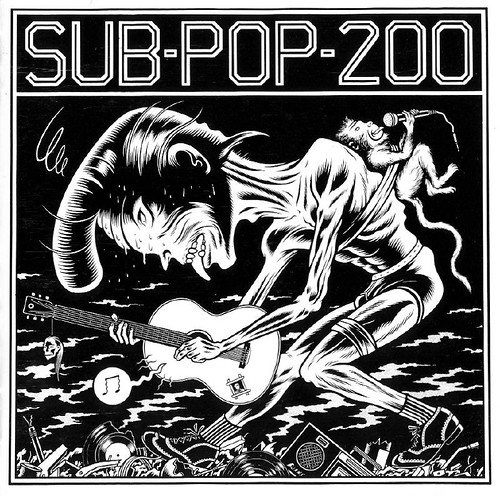
Sub Pop 200 is the second label sampler from, er, Sub Pop. Still one of the most successful independents to this day (one might argue that's down to major-label distribution deals but this is beside the point), the music may have broadened out a bit and calmed down for the most part, but there are still some great bands on their roster, the Flipper-meets-Jesus Lizard antics of Pissed Jeans being a favourite. Here's the list.
This compilation though, is a five-star snapshot of the times, capturing the nascent Seattle grunge scene when it was still a homegrown explosion of scuzzy distortion, tattered jeans and plaid. No international unit-shifters here in 1988, no copycat, watered-down nonsense, and a fair few surprises.
^ Great fat blokes in rock & roll - how many can you name?
For the most part you get hot and heavy, revved-up, slowed-down hardcore mixed with 70's hard rock theatrics; but look out for an acid-munching wall of FX from Screaming Trees, lo-fi college radio stalwarts Beat Happening with easily their least annoying song (a Suicide-esque dirge), the tedious spoken word of Steven J. Bernstein and the de-tuned home recording of the Thrown Ups (great track). The best thing about Sub Pop 200 though is not just the quality of the obscure bands, but also the total absence of sheen that would characterize the later albums of the more successful groups, bar the obvious exceptions. I guess in 1988 they were still young, filthy and hungry... that's certainly how it sounds. Oh, and almost all of these songs are exclusive to the compilation. Whatever happened to the fine tradition of the label sampler? Cracking semi-relevant article here.
So, Sub Pop 200 - yet another reason to thank our lucky stars that Black Flag decided to grow their hair...?
The fat man yipped dirty words at my ears and the guitars screeched a cavity into a 15-year old brain. It was visions, drugs and hysterical laughter I had never experienced in my own short life. There were songs with names like The Thing, Wave of Mutilation and Dancing the Manta Ray. As long as I had my Walkman in hand this CD would never leave it...
One of the first records (okay, CD's) I ever bought (link)was based on a magazine review. I neither knew who the Pixies were or what a B-side was... On this CD is a song called 'In Heaven Everything Is Fine', which was poached from the Lady in the Radiator scene of this 'dream of dark and troubled things'...
...Which in turn was directed by video artist-turned-filmmaker Dave 'Happy Meal' Lynch. Here's David Lynch talking about the manifold benefits of a handy-dandy iPhone:
These chaps released one 10-track mini-album during their 4-year unsigned tenure on the Dorset scene: 'Standing in the Way of Progress' - a 4-track tape recording bursting at the seams.
Prodigious, idiosyncratic and political, they would have thrived in a post-industrial, Cold War-comedown psych-scape.
The curious, questioning and experimental heart of pop music lives on through records like this.
Henry's Phonograph -
Standing In the Way of Progress(mediafire link)
1 She Said: 'Live In the Now!''
2 The BBC Took My Baby Away
3 U.S. Empire
4 Purchase, Purchase, Die
5 Interlude
6 Untitled Anthem
7 I Meant To Kill Him
8 Meier's Trumpets
9 Bullet Wound Blues
10 So I Went Home And Listened To Led Zeppelin

'Girl I Want You, Dead' (Unfortunately I was so baked when I saw this
amazing set I couldn't stand up, luckily for posterity someone filmed)


'Sex, We've Got You Now' at the Overtoom 301, Amsterdam