I tried to pare this down, I really did, but it couldn't be done with a clean conscience. So here you have a 10-song sampler of the work of Victor Lovera, a Nashville-based songwriter and muse/sometime creative partner of R. Stevie Moore, who, as anybody who is familiar with this WEBPAGE or its author will know, is by far my favourite one-man musical tornado. Lovera was, from the evidence on this Moore-compiled double album of his songs, an arch-druid of mostly contemplative and personal minor-chord songs; at least in his later recordings chronicled here - he began with Moore in possibly Nashville's only hard rock/glam/Zappa-influenced group Ethos and could do a mean power pop. I have never truly been a connoisseur of singer-songwriters, so it takes something really special to get me hooked (here the awkward, uninformed attempt at musical analysis); and Victor had a great ear for a satisfying chord change and a calming voice, paired with a feel for classic, universal lovesong lyrics and, yes, a goddamned sense of humour.
His more playful uptempo numbers are good fun, whipping out the assisted high harmonies, but for me these home recordings will always recall a sense of kinship, sorrow and mystery; seen, as Lovera is by the limited Youtube audience, as a disheveled and peripheral figure in the RSMlifelense - a streaming artistic audiovisual feed of sorts stretching back some 35 years. This feeling can be summarised neatly in the multi-part camcorder document of Lovera's visit to Moore's New Jersey home in 1991 - it was the song 'Gleason', below, which first caught my attention.
I believe that these days, amongst all the web-paradigms, they'd call this user-generated content. But there is something sincere and candid in the almost unselfconscious home tapes of the pre-spiderwebs generations. Lovera's maudlin demeanour, which I am speculatively romanticizing, is no doubt partially explained by the unfortunate fact that he was a sufferer from Crohn's disease, which tragically claimed his life in '98. In place of any sense of injustice at the non-exposure of thousands of such worthy artists (LoveraMoore foremost), I merely count myself fortunate to have encountered these people and their music in my virtual travels. Could VicLo ever have imagined that people as far flung as the grey skies of Norwich UK would be shuffling around with his songs on their iSplod on an autumn's day?
The songs included are taken from 'Love Lovera, Last Victor', available for $$$coppagehere and only here (near the bottom). They are mostly home recordings from the mid-80s to the mid-90s. Amongst them, 'It Sparkles' is 1996's latter-day classic (RSM rearrangement here); 'Jackie' reminds me of the intro to Love's 'Laughing Stock'... what can I say about the rest, they are just heart-rending and whimsical songs by a ''real down-to-earth cat''. Enjoy!
The compilation sampled here constitutes just a small part of Victor's output; he was in many other bands and it's all chronicled and sold through Steviehub. Here is the main page from which you can navigate through a plethora of info http://www.angelfire.com/nj2/cdrsmclub/3/vl/victor1.html
Right, a bit of a break from the norm here as this is not an album share; but I've included a few streams for you to peruse whilst you deliberate on taking the monumental risk of actually paying FIVE POUNDS for an excellent record by a lovely person whom, in all certainty, deserves the money.
Powdered Cows is the solo alias of multi-instrumentalist songwriter Martin Roberts, resident of the rolling hills and sweaty crevices of Dorset (this is an important factor as we shall find out).
Compared to the playful noise-jazz chaos of one of Martin's many group projects, Skitanja, the Powdered Cows output is predominantly of the introverted, reflective indie-folk variety. I'm crap at hearing lyrics, but based on the artwork and song titles this album is inspired by very late nights and the 'blissed-out' (as a friend recently put it) atmosphere of the countryside in the South West. It's my belief that the closer to nature you are, the closer you are to the essence of life, and this is reflected in the Powdered Cows listening experience, which is quite ethereal. 'Descent From Animals'.
From track to track the permeating sound is hushed and reverential, even when things take a darker turn it's as if Martin were staked out at 3am with Bill Oddie, waiting for a badger to emerge from its burrow. These references to nature shouldn't be misread as New Age philosophy either - think more along the lines of British Sea Power, a pastoral Englishness and celebration of peaceful life, with a dash of spirituality.
A lot of work has gone into the production, and each track is layered with instruments, synths and samples of all kinds: woodwind, strings, trumpet, drum machine, accordion, toybox, to name but a few. It's the sound of a musical collector bringing his toys out of the loft to play. But what really ties this record together for me are the sound samples and the hissy gramophone-like effect on many of the tracks. We hear birds crowing, what sounds like pattering rain throughout 'Eyes of Knives', radio static, a kick-drum that almost recreates the sound of a record skipping on 'Little Red Lilly Beetle', and a denouement that, appropriately, reminds one of the 'Lonely Man' theme...
Every song is legitimately catchy, but it's easy to overlook this amidst the homespun, secretive ambience of the album, which is only punctuated in the first half by Angus Rudd's driving drumwork featured on such tracks as 'Hidden Tapes'. This actually rocks in a subdued, post-punk way and is one of my favourites on here; with an intro that sounds like a processed organ feeding back, and a highly satisfying Doctor Who tone in the chorus. The Doctor Who tangent might also take us, by way of the BBC Radiophonic Workshop (also featured here) to the 21st century's Ghost Box label and its esoterical manifesto of mysticism and the paranormal; a thread that I feel Powdered Cows picks up on, at least in spirit.
Resykld: Who would've thought the popularity of the Red Hot Chili Peppers (whom popular opinion holds to be a gaggle of gurning, shirtless Californian twats with a few conversely great LPs to their name) could be indirectly responsible for an album like this?: A home-recorded double album of avant-garde, dissonant demons ('92 & '94 respectively) by guitarist John Frusciante. This is up there with other shadow flowers like Oar and the Madcap Laughs, except even more abstract in its style. Whereas Skip's music was a schizophrenic mess and Syd was just shot-away, Frusciante is not of that generation, and through the 90's was an extremely reclusive, emaciated crack and heroin addict with his head tightly screwed on and free of whimsy.
The songs/instrumentals are warts-and-all, frequently detuned, almost ignore melody (but not really) and sound as if they were written/recorded on the spot, freeform. If this spontaneity was the method, Frusciante's four-track tape machine (my favourite recording tool incidentally - because it forces you to make the most of the little space available) captures and preserves these moments of torment uninhibited. These recordings do not answer to gravity, they have their own laws and operate in an emotional and musical vortex. If you have experienced such a vortex or are capable of stepping into one, then you will 'get' Niandra. And no, you don't need to enjoy his group work, Frusciante has his own muse.
Listening back to this album by a physically withered, disintegrating individual, it seems miraculous that Frusciante managed to emerge the other side of the 90's; and go on to use his considerable talents to forge a decent solo career... but he'll never write like this again. He escaped the vortex, stepped through a waterfall, and today explores a different kind of spirituality. For all their macho sex-funk and Hendrixising, the Chili Peppers' constituent members cite an eclectic range of greats for influence, and Frusciante would go on to make some excellent, introspective and ambitious music off the back of post-punk/new wave/krautrock obsessions. On Niandra however there is no trace of this later polish, it's a totally unique and isolated document - on its own planet musically and deeply personal, achieving a sort of metaphysical junkie plateau. The mistakes are left in, and anything resembling a pretty song is quickly ravaged with psychedelic tape effects and everything from tormented howls to banshee screams (made even more inhuman by occasional pitch-shifting). It's sad, ugly and beautiful. When he finally rejoined his old group in 1999, cleaned up, Frusciante had lost all his teeth to infection and received extensive skin grafts for needle abscesses. He also suffered severe burns after his crack den burned down. Ladies and gentlemen:
Exciting things are afoot, as a (slighty ammended) version of this article with two whopping R. Stevie introductory mixes has just been contributed to the best new music community-cum-blog this side of anything: A Future In Noise. Go catch it and see how proper music blogs are done:
Visit the labyrinthine homepage which is, aptly, as large and confusing as his back catalogue
Right, lots to cover here... well, R. Stevie Moore is by far my favourite multi-talented, progressive popster/composer of all time. The very, very true definition of Mr. all-round, prodigious prodigy man. Now reach into your mind, pick a genre of music. Got one? He's done it, and better than you or I could ever hope to.
Imagine if the Beatles had arrived a decade later, through a freak radioactive laboratory explosion all inhabited the same body, and as a result of their horrific appearance never made it big. They'd still find a release for that geyser of creative talent by any means possible, right? What's the alternative? D.I.Y. RECORDING - play all the parts yourself, produce yourself, record yourself, mix yourself... In your living room. Not a pastime that was as universally accessible as it is nowadays by a long shot, but come the 70's you certainly had the means. This aggregate mutant-Beatle would probably need to decide on a name too...
Robert Steven Moore started out in Nashville, TN, home recording on a reel-to-reel tape machine that his session musician father used to lay down demos. Bob Moore Sr. was not just any session man but a Nashville fixture who played on many a country standard, as well as being Elvis Presley's touring bassist for many years. And thus Bob Jr. was born and raised around legendary musicians rehearsing in his childhood home; he appropriated the primitive equipment they left behind after heading off to the studio, made it his own and will undoubtedly die a myth of the medium.
RSM is generally regarded as the grandfather of 'lo-fi' or low-fidelity music - a title originally given to a wave of indie bands in the 90's, who used tape noise and the side effects of simple four-track recording techniques to enhance a certain quality in their music. But this hack-conceived pigeonhole did not exist in the decades before Pavement, Beat Happening and Guided By Voices, and innovators like RSM got a comparatively microscopic amount of credit for their work...
...Which is tragic, because whilst the aforementioned popular groups' early work was characterised by the fashionable fuzz that draped a veil of mystery over some good songs; RSM accomplished so much more, turning his home studio into a factory for boundless creativity, where anything and everything (except high fidelity) was possible. The 'lo-fi' element seems more owed to budgetary constraint, and is frequently manipulated or pushed to absolute breaking point with techniques like track bouncing. He cultivated a love and mastery of cheap equipment, but it never defined his work. But the recording quality had improved by the 80's, and with the advent of the digital recording era RSM eventually caved in and moved on from tape to cleaner pastures, but the rampant unpredictability of the music has not suffered in the slightest.
What makes this man's obscurity all the more depressing is that from 1974 onwards, he was creating accessible-to-your-grandma pop classics, whilst staying true to all the tenets of art rock, doing just about everything in between and maintaining his passion for instrumental music and the avant-garde. RSM even anticipated New Wave by a good 4 years, fer chrissakes. And what do we have to show for it - just over 7000 listeners on Last.fm, which doesn't even match the listener count of 21st century pupils like Ariel Pink.
^A weirder offering from just after the make-or-break of the major label courtship era, with backing band. Props to A. 'the Face' Rudd for turning me on to Moore a year ago
Despite the tireless local support of New Jersey public access, radio stations such as WFMU, many a frenzied podcast and a demi-God reverence amongst his thin but far-reaching and dedicated fanbase (I've personally talked to fans from several continents, apparently he's a fixture in Bogota), Mr. Moore is quite human, and some of his best material has arisen from sour grapes. Exasperated by a lack of progress, he even called the music thing quits for a few years in the late 80's but returned in 1991. The intervening period was spent exploring a booming medium: home video. The fruits of this era and beyond are archived on Youtube in theirhundreds, and are forever growing in number.
Blimey, did I forget to mention he's self-released all his material via a home-delivery service since the late 60's? Why yes I did. Once known as the R. Stevie Moore Tape Club, now the CD-R Club, he's put out over 400 tapes and is still going full tilt. I personally own about 20 of them, many from the 'golden period' of the mid-70's to mid-80's, but truth be told he never disappoints no matter the decade. Understand that these 'tapes' (hereon in I'll use this term to refer to the CD-Rs) do not constitute his official discography of independent label albums, which are all instant classics and essentially distilled compilations of his material.
But as a matter of principle for a struggling artist, what tapes I choose to include on here will NOT have any of the CD-R bonus tracks or scanned artwork. These often include not just songs but 15 minute+ sketches, radio spots, even complete concept albums... a lot basically. The main aim here, as always, is to share my enthusiasm and spread the noise about the best music. The more fans this guy can get, the better, and hopefully in tandem with the inevitable documentary, RSM will one day get the mainstream recognition he deserves.
^Yeah yeah, I am one of the 'lunatics with no life', and proud =D
R. Stevie Moore's range is vast, but if you appreciate musicks, and in particular any of the following: the first 5 years of Zappa, the Beatles and their legacy, 10cc, XTC, Talking Heads, Ween, prog rock, Eno soundscapes, the avant-garde, or any number of post-punk and lo-fi artists... you would do well to check this guy out. Where to start, you ask? UK label Cherry Red recently put out the perfect introduction, and a follow-up compilation is imminent.
Get some Mo' Stuffs (this is 1974's 'Stevie Moore Often', one of the very first cassettes that adopted the more popular song-based format he is 'known' for, and jolly nice it is too. Includes early versions of staples like 'Why Should I Love You'.)
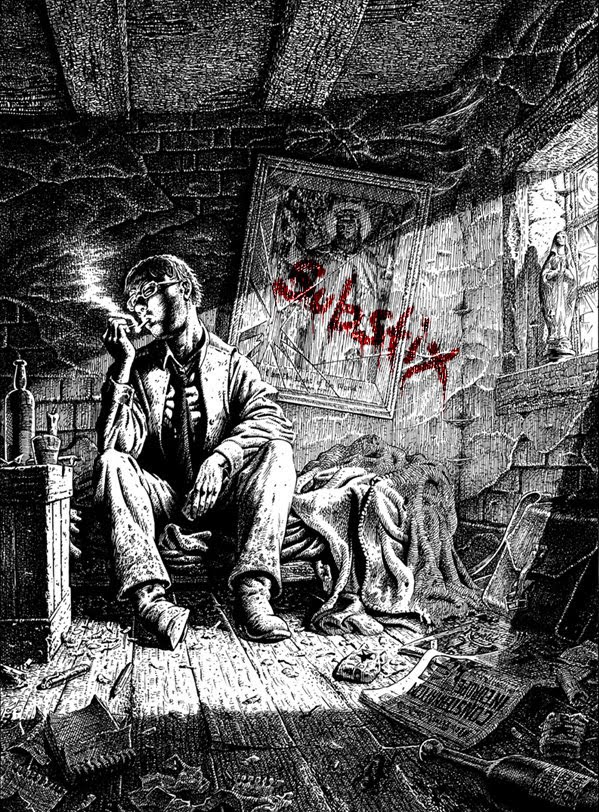
 I tried to pare this down, I really did, but it couldn't be done with a clean conscience. So here you have a 10-song sampler of the work of Victor Lovera, a Nashville-based songwriter and muse/sometime creative partner of R. Stevie Moore, who, as anybody who is familiar with this WEBPAGE or its author will know, is by far my favourite one-man musical tornado.