The most eclectic and unconventional sounds of the post-hardcore variety. Words seem pointless here, plus I ain't got the brain for many. Luminary of the great Washington D.C. scene Ian MacKaye leads us throo noise rock, Beefheartized punk, downbeat instrumentals, a distant reggae flavour (scratchy guitar lines, 'Ring The Alarm' reference on track 7?) and some of the best dual guitar work you'll hear this side of... Slint or Sonic Youth, I suppose. Former members of Rites of Spring (who also featured in this D.C. 'supergroup') see to that, and Picciotto's vocal earnestness counters MacKaye's classic pubescent punk growl perfectly. Almost in-credibly good. The wheels were removed at some point and these guys just decided to clear their own way, off the beaten path. Even the faintest animal tracks seem to have been eschewed in favour of... this ... Checkit out. Gotta love dem righteous Fugazi/Dischord business/performance ethics too! And to think we were mired in Britpop.
As a bloke on the Boobtubes comments: ''Genres are for fucing books. This is music.''
Every bit as awesome as you'd hope for. Unlike Danger Mouse's excellent Jay-Z/White Albummashup, most tracks here do not actually utilise Beatles samples as the basis for a cultural conflation. Rather, Caruana exploits obscure instrumental Beatles cover version: latter-day RZA-like horn motifs blowing soulfully away on Macca's 'Live and Let Die', a Hammond organ riff on 'And I Love Her', or at one point, oddly, a surf instrumental to the tune of 'You Won't See Me'... Cheeky and potentially disastrous, but it works. The overall quality of produckies is high, Caruana is an ace mixer who fills in the gaps inventively; and the Beatles seem little more than a convenient melodic device for a hip-hop redux. Cause let's face it, they were a hook factory. The rhythmic instincts and sometime 'lyrical esoterics' of the Wu are carried through, but given a new lease of life with fresh beats that merely happen to be reappropriated from Thee Hoali Beetles canon. It's a hardcore hip-hop album first and foremost. Vocals are lifted from not just Wu-Tang tracks but also the respective members' solo careers, it's gloriously l-o-n-g, the Beatles/Ol' Dirty Bastard skits are classic (heareth) and it's freeeeeee. Or at least it was until the bandcamp.com profile got taken down. Haw haw.
Click the picture above before this shit gets removed by the EMI attack dogs!
One of the few instances of extensive Beatles hook-sampling, this one from 'She's A Woman' with a Ghostface Killah vocal overdubbed:
Dedicated to the late, great Dirt McGirt. If there is a heaven he is up there getting wrecked.
^A painting by Max Parrish, whose 'Daybreak' is the album's cover-art
A deeply unusual and beguiling one-off here (not me, the album). The delectable Peter Murphy of Bauhaus and multi-instrumentalist Mick Karn (ex-Japan) came together for this totally unique celebration of Middle Eastern modes and Paganistic themes; conjured almost entirely by complex, interwoven fretless bass and synth lines. With a number of exceptions, the fretless bass' sound can seem dated as it instantly recalls an era. But similar to the iconic and fluid basstones featured on Kate Bush albums from the period, it just feeds into the strangeness and in the case of Dalis Car, sets the scene.
Murphy was surely one of the classic post-Bowie New Wave singers, bold and brazen. Karn brings the dark, synth-based ruminations of Japan to the project. The programmed drums are barely noticeable and rendered almost superfluous beneath the album's mirage. This is far from simply Bauhaus meets Japan - it carves out a mystical exoticism, at a time when many artists of renown (Byrne, Gabriel, Eno etc) had recently succeeded in bringing the alien rhythms of various 'world'/ethnic musics into synthetic Western pop.
Dalis Car is pretty left of field however, being unsettlingly hypnotic and instrumentally upside-down. The minimalist approach to the compositions is fleshed out by excellent production and timely touches of distant guitar and woodwind. If you're a fan of the cold sounds of Talking Heads'Fear of Music, Bowie'sLodger, or the gothic New Age-isms of Dead Can Dance in general you can't afford to miss out on this. BEWARE 'Cornwall Stone'.
Resykld: Who would've thought the popularity of the Red Hot Chili Peppers (whom popular opinion holds to be a gaggle of gurning, shirtless Californian twats with a few conversely great LPs to their name) could be indirectly responsible for an album like this?: A home-recorded double album of avant-garde, dissonant demons ('92 & '94 respectively) by guitarist John Frusciante. This is up there with other shadow flowers like Oar and the Madcap Laughs, except even more abstract in its style. Whereas Skip's music was a schizophrenic mess and Syd was just shot-away, Frusciante is not of that generation, and through the 90's was an extremely reclusive, emaciated crack and heroin addict with his head tightly screwed on and free of whimsy.
The songs/instrumentals are warts-and-all, frequently detuned, almost ignore melody (but not really) and sound as if they were written/recorded on the spot, freeform. If this spontaneity was the method, Frusciante's four-track tape machine (my favourite recording tool incidentally - because it forces you to make the most of the little space available) captures and preserves these moments of torment uninhibited. These recordings do not answer to gravity, they have their own laws and operate in an emotional and musical vortex. If you have experienced such a vortex or are capable of stepping into one, then you will 'get' Niandra. And no, you don't need to enjoy his group work, Frusciante has his own muse.
Listening back to this album by a physically withered, disintegrating individual, it seems miraculous that Frusciante managed to emerge the other side of the 90's; and go on to use his considerable talents to forge a decent solo career... but he'll never write like this again. He escaped the vortex, stepped through a waterfall, and today explores a different kind of spirituality. For all their macho sex-funk and Hendrixising, the Chili Peppers' constituent members cite an eclectic range of greats for influence, and Frusciante would go on to make some excellent, introspective and ambitious music off the back of post-punk/new wave/krautrock obsessions. On Niandra however there is no trace of this later polish, it's a totally unique and isolated document - on its own planet musically and deeply personal, achieving a sort of metaphysical junkie plateau. The mistakes are left in, and anything resembling a pretty song is quickly ravaged with psychedelic tape effects and everything from tormented howls to banshee screams (made even more inhuman by occasional pitch-shifting). It's sad, ugly and beautiful. When he finally rejoined his old group in 1999, cleaned up, Frusciante had lost all his teeth to infection and received extensive skin grafts for needle abscesses. He also suffered severe burns after his crack den burned down. Ladies and gentlemen:
Here the Berlin group, led by the positively demonic Blixa Bargeld, expands its sound, underlying the metallic clatter and grating noises of the first album with something resembling a pulse (quite literally, on one track). The disturbing, minimalist sound still reigns but it's much more textured and varied this time around; O.T. is one of those albums where you will have it on in the background and mistakenly think you have been through half of it, only to check the tracklisting and find you've been listening to but a single epic composition. This progression is one reason I consider Neubauten's 80's period to be great.
We are not in the territory of conventional songwriting yet, no choruses or verses are here to give you a tether into popular music or safe familiarity, this is the world of Collapsing New Buildings - the constant disintegration and perpetuation of disposable modern structures (ideals as trends, cultures, powers-that-be, people?). You might say that musically and lyrically Neubauten are deconstructing it all themselves, but I think they had aspirations to destruction as well: 'I am waiting on the edge of the world for the new sun which burns more than it shines /The president howls at the grave of the HMV dog / And the newsreader bears his honest as bones face / The station ID, a blow on the bones.'
A few aspects of the broadening and deepening of the Neubauten sound, which has a resonance different to that of the masochistic appeal of the debut: - synth burbles, circuit buzzes and static that provide a lower register to the found-sound ambience, which are fleshed out with a wider range of objects being struck/plucked/scraped etc - at least twice the number of tape tracks (seemingly) in use, with several dedicated to analogue sampling and field recordings (a Hamburg fish market being one, apparently) - occasional use of atmospheric, Central African-sounding woodwind and percussion, even dissonant strings ('Armenia') - found sounds like water, animals and, erm, race cars... The eclectic whole makes perfect sense as a coherent, continuous record, with an atmosphere so beautifully executed yet brooding and malevolent it probably belongs in a 'scariest albums' nerdlist. Has to be heard to be believed!
The album title means 'Drawings of Patient O.T.', O.T. refers to this man and gives you some idea as to the darker themes of the album, and perhaps Bargeld's growing sense of isolation from the world. Most of us may not be able to understand the lyrics, but this is not essential, especially when the music is perhaps a most effective narrator that often threatens to drown out Blixa's tortured exultations and improv. Not to detract from his talent as a vocalist (which is part of what defines the group) however, but it is a presence less dominant on this album.
30-year-old (and counting) cult institution from my old hometown of Kingston Upon Thames, brought to you by the ALPHABET BUSINESS CONCERN.
Despite the fact that Tim Smith (the brains of the operation) has always vehemently rejected the 'progressive' label (he prefers simply 'pop' or 'psychedelic') it is a reasonable point to raise: in Cardiacs' music there is a fondness for unusual chord progressions, chord modulation, and compressing the equivalent of a prog epic into 4 minutes or less... All with the energy of a '77 band. Cardiacs also opened for Marillion in the 80s, apparently Fish was heartbroken when the fans did not take to them... It's natural that an amateur such as myself who can't write for toffee should always seek to pigeonhole a sound for n00bs, but the Cardiacs are infamous for being one of those idiosyncratic oddities who sound remarkably similar to nobody except Cardiacs. The only comparisons I can come up with are the more anarchic, ambitious New Wavers like XTC and Split Enz (particularly the latter's early years), mixed with the avant-rock of Henry Cow... Infact they straddle all types of 'progness' whenever they feel like it, perhaps playing symphonic Yes-ness one minute and unhinged Gentle Giant sing-songs the next. That's the remarkable quality of this band, there are seemingly no limits. But you can always relying on the delivery being OTT to the point of ridiculousness and bewilderingly melodic - you know that this is Tim Smith's idea of how pop music should be. They are also obscenely tight live. Unfortunately Smith suffered, erm, a cardiac arrest in 2008, and it's unlikely you or I will ever experience a 'religious' Cardiacs performance.
I think this is as clear-cut a case of love 'em or hate 'em as you will ever encounter on this blog... Unacknowledged genius or bad acid trip in a fairground? Or are they just trying too hard? I don't think so personally, plus buried in the lyrical abstractions are some statements somewhere I am sure of it, which keeps me listening. Presented here is 'Sing To God', a 1995 double album which will leave you laughing hysterically, then slack-jawed in disbelief as each track reaches new heights of structural insanity and musical prodigiousness. And then the injustice of it all hits you, that by this time the 'classic' Cardiacs line-up had shrunk to a quartet, and they actually somehow played this shit onstage, constantly, to comparatively tiny audiences of loyal fruitcakes. It's just not fair. God bless Cardiacs. This is from the album, easily the most insane piece of music I have heard in a long time
''My Life in the Bush of Ghosts is a novel by African writer Amos Tutuola from Nigeria published in 1954. This novel recounts the fate of mortals who stray into the world of ghosts. The 'bush' is in the heart of the tropical forest, an impenetrable thicket left even after the rest of the forest is cleared for cultivation. Here, as every hunter and traveler knows, mortals venture at great peril, and it is here that a small boy is left alone.''
This album, from the very definition of adynamicduo, is instantly recognisable as being in a genre all it's own, like 'Entroducing...' 25 years before the fact and accomplished not with samplers, but with simple manipulation of the raw tape; from Eno's recordings of radio call-in shows, evangelists, and the various Arabic samples that help to give the album it's haunting quality. Despite an underlying funkiness adeptly provided by Byrne playing most of the instruments (underrated musician that he be), this is a different beast to Byrne & Eno's work on the previous 3 Talking Heads albums.
The fascination with African polyrhythms remains, but as a listening experience it it free of associations with the oeuvre of either artist. The album takes on a life of it's own through the strange grooves characterized by found objects and African percussion, overlayed with those voices from disparate places in languages we can't understand - everything is out of context and the effect is supernatural and, like I said, unique. I've always loved this record and the only thing that comes close (despite all the claims of inspiration by other musicians down the years) is David Byrne's mostly-instrumental 1981 album 'the Catherine Wheel'. Innovative? Probably, 'My Life...' was obscenely ahead of it's time... but nobody went on to imitate the hands-on analogue sampling technique of this album (understandable given the headache it must have been without MIDI). Perhaps that's why sampled-based albums have rarely been so otherwordly? Having said that this would make good rush hour listening; it captures the cold and hollow functionality of an overpopulated urban area whilst being tethered to a sombre spiritual ancestry.
This is the 11-track CD edition (not the whopping 2006 reissue, but you are welcome to buy it for me =P), it's bloody marvellous and of course doesn't include the long-gone but fitting track 'Qu'ran'. The Islamic Council of Great Britain wasn't having a track that sampled readings of the Holy Book, and who were these two nerds to argue? It was struck from the running order, replaced with the B-side 'Very, Very Hungry' and has remained absent from all subsequent reissues. However you can hear it by clicking the link a couple of sentences back.
Here is the extremely cool official website of the album. The samples Eno originally used have all been made public domain so you can download them and do your own mixes. There are also streamable tracks and essays by Byrne about the production of the album and it's connection to the Tutuola book. And for shits n' giggles here's David Byrne's web-o-log, which is surprisingly good reading... and he doesn't even have to upload any albums?!
With noted electronic composer Ryuichi Sakamoto's first band, Yellow Magic Orchestra, you could always be sure that each album would bring something new and thought-provoking. From 1978-1983 YMO consistently broke new ground, beginning as the Eastern-mode equivalent of Kraftwerk (but more inspired by 8-bit videogame music and the classical training of their respective members), going on to pioneer electropop and finishing on a high note with 'Naughty Boys' - probably the only J-Pop album that is essential listening - which made them huge stars in China of all place (having already become more of a 'Japanese Beatles' than even the Spiders ever were).
Sakamoto (keyboards) went on to collaborate with just about everybody and win Oscars, Haruomi Hosono (bass) and Yukihiro Takahashi (drums) maintained electro-god status in the Far East; in a way they were a pre-emptive super group. On top of that YMO were the first Japanese band to aspire to, and attain, worldwide acclaim and influence; the shared vocal duties were multi-lingual (Korean, Chinese, French, and English lyrics written in collaboration with Chris Mosdell) displaying a desire to break down perfunctory international barriers that have no place in music. They even got on Soul Train with their hit cover version of the anything-but-tight 'Tighten Up'! You'll find it's actually nigh-on impossible to listen to classic hip-hop or the various nascent dance musics of the 80's without hearing YMO samples...
This album, 'Technodelic', is their fourth, which as well as being a marked development from their first two bonafide classics (I don't have the third) is probably my personal favourite. It's well known amongst DJs and dance pioneers as being one of the first albums to make extensive use of samplers, and I don't mean just a drum break or the odd bit of speech. On 'Technodelic' you can hear the beginnings of the ethno-funk, anything-from-anywhere-goes style that Sakamoto is famed for, but it's not the whole story. This one is darker in places, with a wider palette than anything YMO had previously attempted, but it retains that sense of playfulness that makes them SO much fun to listen to; and the whole thing's propped up on the prodigious playing skills of the trio. I first encountered Yellow Magic Orchestra (a name one assumes is tongue-in-cheek) upon reading a magazine review of all the newly-remastered albums back in 2004. It timed in perfectly with a borderline-Japanophile phase and my discovery of the African polyrhythms of Talking Heads, and I ended up getting four Why 'Em Ohs on CD. This is ripped at 320kbps but I couldn't be bothered to scan the artwork, sorry. If anybody demands it I'd happily oblige however!
I think I already mentioned that this second instalment trumps the first free-P 'Earth' in several ways that are entirely accountable to my personal taste. Each track still reverberates with creative energy, and with the smorgasboard of sound flavours on offer (everything from classic synth sci-fi zaps to feedback and ethereal drone loops) you really wish it had some kind of visual accompaniment. Actually, I recommend switching on your media player visualizations while listening if you really want to be absorbed in the experience. Now for my customary game of spot-the-genre. On this release the brief is much longer. The Nick Silva collaboration '00000003' in particular is a fluid Dalek-like synthesis of hip-hop and MBV noise drones, the 'Ice Water Girl' remix is a totally unexpected funky d'n'b track and 'Sleep Wheels' is almost a return to Roxie's videogame soundtracks of old but doused with Sonic Boom's influence on her music since, with haunted castle apeggios. An awful lot to get your teeth into for a 15, maybe 20 minute-long download.
Without traipsing over all the benefits of the medium again, and how tantalizing five tracks of highly-focused artistic collisions can be, I will say that the elements theme continues to be integral to the feel of these projects. Whereas tracks like 'Aum' from the previous offering recall ancient stone monoliths roused from a thousand-year slumber, 'Water EP' retains the timeless feeling but debunks to Atlantis. In fact it brings to mind that HP Lovecraft story (remember the title? Fat chance) about a lost and damaged German U-Boat in it's death throes, the last surviving crew member stumbles upon an ancient city in the forgotten recesses of the deep, with the battery that powers the submarine's torches running out... and some crazy shit goes down. At least I think it was a U-boat. Any takers on this?
Having compared the subject of my previous post to electronic composer Delia Derbyshire on more than one occasion, I thought it would be good to follow through and let people know just who the hell I was talking about.
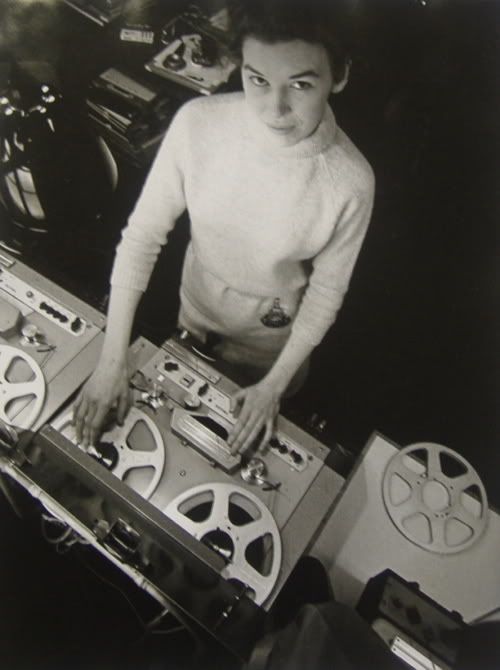
The late Ms. Derbyshire was first attached to the BBC's 'Radiophonic Workshop' in the early 60's, along with other drug-free young talent like Brian Hodgson and John Baker. The Workshop was a venture that, over four decades, became the BBC's very own in-house music and sound effects unit; producting for an extensive range of radio and television programming, as well as acting as an alternative to the expensive practive of music licensing.
From it's early days the Workshop was a hotbed for 'budget experimentation' that sought to make soundtracks and create a library of BBC sound effects, without having to hire orchestras and freelance composers. It was a coming together of maths/physics PhDs, BBC jobsworths and hundreds of miles of magnetic tape; the results were some of the most otherwordly and prescient electronic music of the twentieth century.
46 years on, the Workshop's biggest achievement in the public eye still remains the supremely weird proto-techno of the Doctor Who theme, and with good reason. It's hard to believe when you hear it, but this was made before the rise of polyphonic synthesizers (although oscillators are put to good use here); with Derbyshire actually taking Ron Grainer's original composition and realizing it in the manner that would become a signature of the Workshop - manipulating and splicing pieces of analogue tape by hand. The recordings being (literally) cutted & pasted were typically single tones made by instruments or, most commonly, 'found sounds' (bottles, bicycle wheels, anything goes). This approach must have been spurred on by the musique concrete avant-garde of the time... In the 60's at least, the Workshop very much reflects a playful spirit of the age, one that permeated everything from pop music to sound engineering.
The real genius of it though was in the twisted imagination of the music, and the skill these people must have had to build, layer upon layer, highly complex tracks: pulsating bass rhythms overlayed with effects, glitches and washes of sound rendered under such unique conditions as to actually seem extraterrestrial in origin... all with a mathematical precision necessitated by the clumsy, pre-sequencer technology. However the warmth of the analogue sound is more organic and personable; despite the arduous labour that went into making these tracks, generations of British electronica producers will testify that the Workshop was decades ahead of it's time, pre-dating the boom of cerebral, intricate electronica in the 1990's. Just listen to this unprecedented music and imagine - it was all handbuilt from scratch, not cobbled together through some unfathomably complicated monitor interface. At it's best, BBC Radiophonic Workshop was producing the most 'soulful' music you could derive from non-acoustic instruments (without the aid of samplers, which were a long way off).
This limited edition 10'' vinyl box set (compiled, appropriately enough, by Richard D. James' Rephlex label) covers the halcyon days of 1958-75; and by the 70's you can detect the advent of the Moog, also known as Delia's Bane. Not to fear though, because the bar is still set ridiculously high, and the likes of Paddy Kingsland would go on to do amazing work with the Hitchiker's Guide to the Galaxy (listenlistenlisten). Delia and John Baker both get their own discs, and the material runs from inspired bastardizations of radio (apparently a pig-headed British public drew the line at the Radio Sheffield theme); to forerunners for the soundtracks to hellish 80's science videos that some of you might remember from school (parodied perfectly here); to little TV-theme vignettes and beautiful, extended compositions not unlike Derbyshire/Hodgson's seminal electronic-psych masterpiece 'An Electric Storm'. Mesmerizing, haunting and bloody weird... and it's all thanks to the British taxpayer!
So as not to be accused of contributor bias (you'd have to comment to do that anyway, ha!), I'll do the preamble. I wouldn't have taken the trouble to become acquainted with the Roxbot if it wasn't for coming across her Uematsu-like synth compositions, quirky BBC Radiophonic Workshop mini-suites and sometimes ambient, sometimes jarring dronescapes plucked straight out of REM sleep... in that order. Actually I think it started after finding some rare Cornershop albums posted on her blog... but I digress. Aside from the instrumental music I've got a great deal of respect for anyone who exploits the potential of the internet as a free artistic platform, and I don't just mean self-promotion. Rather than reading me list Marilyn's myriad gifts to an ungrateful web-o-sphere, just follow the links below and see for yourself. It's just nice to know that floating on a sea of opportunists and disposable dross (a bit like this overdressed mp3 blog) there are actually some innovators.
The latest Marilyn Roxie project is a planned series of freely downloadable, themed EPs, each release being produced in collaboration with a different cross-section of bedroom musicians over the internet. The remit is as broad as the international palette, although 'Earth' remains vaguely rooted in Roxie's current ambient/shoegaze-inspired style. There's nothing negative (--=+?) I am dying to impart about it either, except that maybe I'm perched uncomfortably on the fence about the track 'Plain Little Game'... But even had the EP's title been 'Beach Party Campfire Ballads in E Minor To Matt Your Dreads To', I'd still be overwhelmed by the ambition behind this project and would still put it to the reader: 'what have you got to lose?'. This is the genius of the (sadly dwindling) EP format - it's not disposable, but neither will it take a chunk out of your afternoon.
Some tracks are more idiosyncratic, exhibiting Roxie's characteristic semi-improvisation, others feel like they have been daubed, mangled or blended by a stranger. It's impossible to guess who is responsible for what most of the time, but that's part of the fun; and the making of this collaborative experiment will no doubt have inspired all the participants and opened up their creative process in some way or other. So everyone's a winner, and nobody had to die. I've heard the follow-up instalment already, due next week, and I'll be posting a link to that because it's actually even better.
When I was around 14, I started going through all my parents' albums I hadn't heard before, and Danielle Dax's Dark Adapted Eye (1988 compilation; it finally went back in print in late 2008!) was one that grabbed my attention most. Up to that point, I'd never heard anything quite like that album, with its strange mix of ethnic, often tribal, sounds, the spooky and vaguely psychedelic, and even country-western motifs, showcasing Dax's diverse and impressive vocal and instrumental abilities. Upon investigating whether there was more material, I found that not only was almost everything of hers out of print, but that she's remained incredibly obscure overall (currently with just around 5,000 listeners and, sadly, nothing streamable at Last.fm), which is quite inexplicable, since she has at least the chops of Siouxsie Sioux, more than enough of Kate Bush's quirky madness, and a strong injection of mysticism. I managed to also track down a copy of Blast the Human Flower (1990) a few years ago at Amoeba Records in San Francisco, and scrounged around for her myriad of other releases on the interwebs Apart from the two out-of-print items I'm offering below, her other releases are available via this post at j's heaven [for Jesus Egg That Wept (1984), Blast the Human Flower, and Inky Bloaters (1987)], *here* for Dark Adapted Eye (particularly recommended!) *here* for the Timber Tongue EP (1995; the title track includes a sample from Faust's "Just a Second (Starts Like That)"!) and *here* for Pop-Eyes (1983; this was her first release, entirely self-made and produced).
Prior to her solo endeavors, she was half of the bizarre experimental group Lemon Kittens (see also 1980 EP Cake Beast, also two additional EPs are at mysteryposter), with other half Karl Blake going on to form the Shock Headed Peters and later returning to collaborate with Dax again. Her last solo output was the aforementioned Timber Tongue EP all the way back in 1995, though she collaborated with the equally odd Andrew Liles on his 2008 album Ouarda (The Subtle Art of Phyllorhodomancy) on a few tracks. Apart from being featured on several of Sire's Just Say Yes compilations and apparently permanent cult status, Dax has gotten far less respect than what she deserves for her innovative, and incredibly still-unique works of musical artistry- now's your chance to get in on the secret!
The appropriately-titled Comatose Non-Reaction: The Thwarted Pop Career of Danielle Dax collects some of her singles and notable songs, as well as some tracks unavailable on any other collection, and serves as a good introduction: Comatose Non-Reaction - Disc 1 - Disc 2 --- Her cover of The Beatles' "Tomorrow Never Knows" is featured on her '90 album Blast the Human Flower, and the single includes both the single and album mixes, "King Crack", and two otherwise unavailable remixes: Tomorrow Never Knows (Single)
This is the last of theimpromptu Tomahawk background posts, although Señor Patton will be making more appearances in the future. The order I've done this in might seem to imply that Tomahawk are the culmination of all these lesser career highlights, but this is not the case... Consider the albums from this and the previous three posts equatable to four ancient historic landmarks, demolished for their composite materials. These are used to build a towering modern facility for the common good, one that affords views of the land around. However the ancient foundations remain the same, a testament to it's workmanship... And somewhere in that garbled metaphor is Mike Patton's quite unfathomable debut record with his first band, Mr. Bungle!
However this wasn't the first major label album he'd appeared on. Having done several cassette-only releases with Bungle in the mid 80's, 1989 saw a 21-year-old Patton assume vocal duties on 'the Real Thing', alternative metal group Faith No More's eclectic third album and the one that launched them on the global circuit. Over this album Patton had no control in the production aside from lyrics, as he was brought on board after the songs were already written, dropping out of college to join. While 'the Real Thing' was far from a conventional album, it was an MTV hit, and responsible for starting an unfair comparison between Patton and Red Hot Chili Peppers singer/frat-goon Anthony Kiedis with their then-similar vocal styles. A bitter rivalry ensued that eventually resulted in axed Mr.Bungle festival gigs (at the behest of the headliners), many a jibe and vindictive 'tribute gigs'.
'The Real Thing' was a hugely successful debut, but Patton merely used it as a springboard to get his first band a deal and to cut an album that fulfilled the previous decade's most bizarre and twisted, avant-garde metal ambitions... complete with horn section!
The objective for Mr. Bungle was and is (three albums in a decade and they've not announced a break-up) an ALL-in-one philosophy. Every style of music that any member of the band can play (i.e. everything) is given space in any one song; consequently I could spend the next twenty minutes reviewing a song, which simply won't do. Oh... maybe just one then =P
^Oh an egg comes out of a chicken Oh a chicken comes out of an egg
Here's a good archetype for the album (see above), 'Egg' is the Bungle-ites anthem and it gives you an inkling of how volatile and unpredictable their songs are. It's like a contemporary progressive rock, except instead of boarding school boys droning on about classical/jazz influences, you just have punk rockers on drugs doing everything else! On 'Egg' you have, in order: funk, polka, ska, space rock, some bad-acid doom metal, a quick freakout combining funk and death metal, then back to the ska figure, after that it kind of goes into meltdown. And that's just under three minutes in to what, on record, is a 10-minute song (my description makes more sense with the album version too =P).
By now you may be getting an idea of the sheer scope a reviewer of this album has to deal with, and at this point I strongly suggest you stop reading and just clarify the situation for yourself. Go on, the words will still be hear when you get back: 256kbps (comprend des oeuvres d'art) Ein,Zwei
I could go on playing 'spot the genre' here, which is tedious for you but good fun for me: free jazz, rapping, carnival music (giving the album it's sinister edge), Middle-Eastern modes, even an elegant strings-and-ballroom waltz to see us off when we finally claw our way out of the rabbit hole... You get the picture. And needless to say it's an awe-inspiring set of musicians indeed that could play all of this and make it look easy to boot.
So while at it's core the album is rooted in funk metal, perhaps evoking traumatic images of a certain rival band's early incarnation; 'Mr. Bungle' is still a groundbreaking concept and essentially the ultimate fusion album... Unless you count the follow-up 'Disco Volante', but we won't go there just yet. Far from being 'a bit like RHCP', Mr. Bungle are quite possibly the little demonseed offspring of that expert manipulator of rock forms, Frank Zappa. And unlike RHCP, you get the feeling Bungle is a tongue-in-cheek project, they're prodding to see just how much they can get away with.
The record presented here is also the easiest entry point for newbies and the epicentre of Patton's two decades of experimentalism, a manifesto on magnetic tape.
Amendment: Bungle did in fact officially split, inamicably, in 2004; and their debut was produced by avant-jazz giant John Zorn.
As I have been stuck on taut, hot n' heavy post-hardcore and so-called 'alternative' metal of the experimental variety, I intend to celebrate this in the next few posts. The supergroup Tomahawk starts this little thread with their self-titled debut album. The following posts will be the defining albums of the various members' careers, something like a jigsaw puzzle of excellence, but first you're getting a bird's eye view of the overall picture.
This 'supergroup' of mavericks who originally came to fame in the late 80's is: Mike Patton on vox, synths and devices: ex-Faith No More/Mr. Bungle and one-man sonic army in his own right, this is his baby and was released on his Ipecac Recordings label; Duane Denison, groundbreaking guitarist from the Jesus Lizard, creates a musical backing of tension/release, weird spaces and time signatures that I've never heard matched; John Stanier: ex-Helmet, unorthodox and jaw-dropping drummer for one of the most influential bands of the 90's; and finally bassist Kevin Rutmanis of devastating sludge metal pioneers theMelvins. Sludge metal is the down-tuned dirge of doom metal combined with hardcore punk, incidentally. =)
Combined, it's quite a tour-de-force. Like all of the members' former projects, this music is not just about simply making a racket, but breaking new ground in an area of music that has a history of pushing the boundaries - this is something that perhaps needs to be explained to those uninducted into the wonderful world of metal.
Mike Patton is widely respected and renowned for a prolific output and his seemingly endless stream of collaborations, but what will really astound the first-time listener is his vocal diversity. 'The man of a thousand voices', he utilises a good few hundred of them on this album, from guttural death metal grunts and eerie falsetto to inhaled shrieks and banshee howls... And that's just the parts he sings. There's also the numerous overdubbed noises, treated vocal nuances and chants that are so standard for a Patton record you forget just how unusual they actually are... In short Patton sets the standard for Tomahawk, their sound is incredibly eclectic and unique, displaying many a non-metal influence, and showing a disregard for conformity that is all part 'n' parcel of the true experimental/'alternative metal' tag. Just compare it to the popular Billboard 100 'nu-metal' of the time, which was essentially a castrated and codified regime of hip-hop-over-metal... How did those guys look at themselves in the mirror every morning knowing there were albums like this out there?
^ Auteur in the theatre of noise
The 'metal' tag is perhaps misleading, as Tomahawk really straddles the divide between metal subgenres and alternative rock. There are no quiet/loud dynamic clichés but it's certainly all over the place, and is definitely the most well-rounded and memorable of the three excellent Tomahawk albums to date. While the album is more focused that the progressive genreric fruit-machine of Patton's first band Mr. Bungle, it's still impossible to pigeonhole from song to song, and that's one of it's great pleasures. For me, as a big fan of Denison's style of guitar playing, this album is a wet dream, coming off sounding a bit like one of the classic Jesus Lizard albums being properly duffed-over by one of my fave vocalists and given 'the Patton treatment'.
There is a common thread, apart from the reliable ability of the band members to confound and surprise, in that Tomahawk is a loose concept album about a serial killer. The only songs that explicitly state this though are the first two tracks: 'Flashback' concerns the protagonist undergoing memory retrieval and '101 North' is about a highway abduction. The other tracks seem to be mostly related to traumatic, regressed memories of the killer's past and his acts of murder. I'll leave it up to you to work out!
Exciting things are afoot, as a (slighty ammended) version of this article with two whopping R. Stevie introductory mixes has just been contributed to the best new music community-cum-blog this side of anything: A Future In Noise. Go catch it and see how proper music blogs are done:
Visit the labyrinthine homepage which is, aptly, as large and confusing as his back catalogue
Right, lots to cover here... well, R. Stevie Moore is by far my favourite multi-talented, progressive popster/composer of all time. The very, very true definition of Mr. all-round, prodigious prodigy man. Now reach into your mind, pick a genre of music. Got one? He's done it, and better than you or I could ever hope to.
Imagine if the Beatles had arrived a decade later, through a freak radioactive laboratory explosion all inhabited the same body, and as a result of their horrific appearance never made it big. They'd still find a release for that geyser of creative talent by any means possible, right? What's the alternative? D.I.Y. RECORDING - play all the parts yourself, produce yourself, record yourself, mix yourself... In your living room. Not a pastime that was as universally accessible as it is nowadays by a long shot, but come the 70's you certainly had the means. This aggregate mutant-Beatle would probably need to decide on a name too...
Robert Steven Moore started out in Nashville, TN, home recording on a reel-to-reel tape machine that his session musician father used to lay down demos. Bob Moore Sr. was not just any session man but a Nashville fixture who played on many a country standard, as well as being Elvis Presley's touring bassist for many years. And thus Bob Jr. was born and raised around legendary musicians rehearsing in his childhood home; he appropriated the primitive equipment they left behind after heading off to the studio, made it his own and will undoubtedly die a myth of the medium.
RSM is generally regarded as the grandfather of 'lo-fi' or low-fidelity music - a title originally given to a wave of indie bands in the 90's, who used tape noise and the side effects of simple four-track recording techniques to enhance a certain quality in their music. But this hack-conceived pigeonhole did not exist in the decades before Pavement, Beat Happening and Guided By Voices, and innovators like RSM got a comparatively microscopic amount of credit for their work...
...Which is tragic, because whilst the aforementioned popular groups' early work was characterised by the fashionable fuzz that draped a veil of mystery over some good songs; RSM accomplished so much more, turning his home studio into a factory for boundless creativity, where anything and everything (except high fidelity) was possible. The 'lo-fi' element seems more owed to budgetary constraint, and is frequently manipulated or pushed to absolute breaking point with techniques like track bouncing. He cultivated a love and mastery of cheap equipment, but it never defined his work. But the recording quality had improved by the 80's, and with the advent of the digital recording era RSM eventually caved in and moved on from tape to cleaner pastures, but the rampant unpredictability of the music has not suffered in the slightest.
What makes this man's obscurity all the more depressing is that from 1974 onwards, he was creating accessible-to-your-grandma pop classics, whilst staying true to all the tenets of art rock, doing just about everything in between and maintaining his passion for instrumental music and the avant-garde. RSM even anticipated New Wave by a good 4 years, fer chrissakes. And what do we have to show for it - just over 7000 listeners on Last.fm, which doesn't even match the listener count of 21st century pupils like Ariel Pink.
^A weirder offering from just after the make-or-break of the major label courtship era, with backing band. Props to A. 'the Face' Rudd for turning me on to Moore a year ago
Despite the tireless local support of New Jersey public access, radio stations such as WFMU, many a frenzied podcast and a demi-God reverence amongst his thin but far-reaching and dedicated fanbase (I've personally talked to fans from several continents, apparently he's a fixture in Bogota), Mr. Moore is quite human, and some of his best material has arisen from sour grapes. Exasperated by a lack of progress, he even called the music thing quits for a few years in the late 80's but returned in 1991. The intervening period was spent exploring a booming medium: home video. The fruits of this era and beyond are archived on Youtube in theirhundreds, and are forever growing in number.
Blimey, did I forget to mention he's self-released all his material via a home-delivery service since the late 60's? Why yes I did. Once known as the R. Stevie Moore Tape Club, now the CD-R Club, he's put out over 400 tapes and is still going full tilt. I personally own about 20 of them, many from the 'golden period' of the mid-70's to mid-80's, but truth be told he never disappoints no matter the decade. Understand that these 'tapes' (hereon in I'll use this term to refer to the CD-Rs) do not constitute his official discography of independent label albums, which are all instant classics and essentially distilled compilations of his material.
But as a matter of principle for a struggling artist, what tapes I choose to include on here will NOT have any of the CD-R bonus tracks or scanned artwork. These often include not just songs but 15 minute+ sketches, radio spots, even complete concept albums... a lot basically. The main aim here, as always, is to share my enthusiasm and spread the noise about the best music. The more fans this guy can get, the better, and hopefully in tandem with the inevitable documentary, RSM will one day get the mainstream recognition he deserves.
^Yeah yeah, I am one of the 'lunatics with no life', and proud =D
R. Stevie Moore's range is vast, but if you appreciate musicks, and in particular any of the following: the first 5 years of Zappa, the Beatles and their legacy, 10cc, XTC, Talking Heads, Ween, prog rock, Eno soundscapes, the avant-garde, or any number of post-punk and lo-fi artists... you would do well to check this guy out. Where to start, you ask? UK label Cherry Red recently put out the perfect introduction, and a follow-up compilation is imminent.
Get some Mo' Stuffs (this is 1974's 'Stevie Moore Often', one of the very first cassettes that adopted the more popular song-based format he is 'known' for, and jolly nice it is too. Includes early versions of staples like 'Why Should I Love You'.)
The second album by Yoko Ono. Her first was 'Yoko Ono/Plastic Ono Band' with the fluctuating supergroup that included John Lennon, and at variously Eric Clapton, Ringo Starr, Phil Spector, etc. It was a companion piece to what is considered Lennon's most accomplished solo album 'John Lennon/Plastic Ono Band'.
'Fly' is definitely up there with the debut, a record that is variously avant-garde and jam-oriented - groovy even - but always experimental in it's approach. For the most part it sounds like nothing else from the period, the only music that came close was the budding 'krautrock' scene, and this was unfortunately lacking in Ono's kabuki-theatre wailing (which is like Marmite, except if you don't appreciate the spectrum of it's abrasive/beautiful range then you're a dick).
Unlike 'Yoko Ono/Plastic Ono Band', which was at times loud and fast and today is still hailed as proto-punk, 'Fly' is more spaced-out, much longer and more of an all-round Fluxus (the Japanese Dada-inspired art collective Yoko represented) statement. Not only was the gatefold sleeve stuffed with sublime frames from the 'Fly' art film and instructions for performance taken from Yoko's 'Grapefruit' book; tracks were culled from various installation pieces (Telephone Piece, Toilet Piece, Airmale is the soundtrack to Lennon's 'Erection' film). On record you will also hear the use of mysterious, specialist 'instruments' custom-built by Joe Jones, a Fluxus artist whose idea it was to evoke emotions yet to be illuminated by sound vibrations.
^ From Grapefruit, to be performed by the reader. Ono's background in conceptual and performance art is all but evident on 'Fly'
Also, if you're a Beatles fan it's interesting to hear the rhythm section of Klaus Voorman (the man responsible for several iconic Beatles record covers) and Ringo thrashing out weird jams with Clapton and Lennon atonally banging away in the background. It feels like they have all been infected with the Yoko virus, and the results are electric.
So this is a must-have, as everybody from Sonic Youth to David Bowie would testify (if that's the kind of convincing you need). Lennon and Yoko's later musical collaborations would get a lot more direct and conventional, the feminist themes a lot less oblique; and in the singularly idiotic 'Yoko Vs. Beatles' debate these great records and Ono's light-hearted and accessible take on the avant-garde have all too often been forgotten. For shame, as you will hear.
This upload is at 320, and it's one of the recent Rykodisc remasters with two bonus tracks and artwork included. Needless to say, if you really, really like it go out and buy the CD - the packaging of the reissue is special.