Showing posts with label compilation. Show all posts

Friday, 5 February 2010

That Motown Sound


A cottage industry that was churning out 110 Top Ten hits like nobody's business between 1961 and 1971; whose productions possess a timeless-yet-nostalgic quality that reduces music snobs and casuals alike to a quivering heap; that was Motor City's largest export after automobiles (and certainly the more culturally significant); to which generations of musicians and songwriters are indebted; the soul/R&B Mecca-Eden and the driving force behind the Northern Soul 'pre-rave' phenomenon in the UK...
What pop music witchcraft is this?
That's a question which I as a lowly music fan am not qualified to answer, but here's a succinct passage poached from that ever-questionable academic resource the Wikipaedos:

Motown’s music was crafted with an ear towards pop appeal. The company specialized in a type of soul music it referred to with the trademark "The Motown Sound". The Motown Sound was typified by a number of characteristics: the use of tambourines to accent the back beat, prominent and often melodic electric bass guitar lines, distinctive melodic and chord structures, and a call and response singing style that originated in gospel music. In addition, pop production techniques such as the use of orchestral string sections, charted horn sections, and carefully arranged background vocals were also used. Complex arrangements and elaborate, melismatic vocal riffs were avoided; Motown producers believed steadfastly in the ''KISS principle'' ("keep it simple, stupid"). Read the rest as you listen, fascinating stuff!


Great, but it doesn't satisfy my affinity for pointless comparative analysis... Ever seen a classic Martin Scorsese movie, noticed his tendency to big, upbeat orchestral soul? That's one aspect of Motown Records. In fact even in the incredibly unlikely case that you've never even heard of Motown, you will definitely have come across at least one of the songs included here during your lifetime; it will take a cattle prod to the withered memory bits o' your brain - as if you're revisiting a long-forgotten childhood... via the gift of ECT.

It's just that 60s magic to some extent, that is: the clean-but-not-over-processed-to-tawdry-shit analogue production, the guitar sound, the characteristic effects and instruments of the era; but it's also the Motown THING. Is it in-house session musician icons the Funk Brothers, the stock songwriting teams (which included flagship singers like Gaye, Robinson and Wonder)?; or is it simply the perfect combination of time, place, passion and inspiration? Probably... What do I know.

So, not to be missed. Should you even consider yourself something of an expert on the classic single-oriented era of Motown, this'll still knock you for six - 38 tracks! But it goes by in a flash, there is plenty of space for the less familiar stuff and each song retains an unmistakable identity. Despite the classic Motown remit outlined above there is considerable variety - check out the gritty, psychedelic garage stomper below!... The total euphoric effect of all this is something like a whirlwind. They truly had pop music down to a science.


...But there's one catch which I have to apologise for. I acquired this in 2007, and it served as my official introduction to a bedrock of popular culture that had somehow been omitted from my upbringing. Unfortunately the mp3s are in 128kbps. I've scoured the blogosphere and online retailers, but nothing matches the title... this first-class delight of a compilation is likely some blogger's one-off. To some people this won't make a difference, but to the rest of you I would still implore you to take the dive.
On the plus side, the occasional dodgy high-ends in the sound neatly replicate the experience of listening to the songs through a transistor radio on the kitchen table in 1966, or dusty old vinyl. If you can find a collection on a par with this in better quality... you are a better man than I, and you should share the wealth in the comments box forthwith.
cheers, J x

Partario Wun
Partario T'u

(Tracklisting in comments)

Sunday, 24 January 2010

V/A - The Beginner's Guide to Thrash Metal

Presented here for your pleasure is a sterling and succinct introduction to the original thrash metal movement, by one of my favourite music fans on the web and stalwart/sugar daddy/patriarch of the Musicbanter forum. Thrash was initially a California-centric scene but was quickly indebted to the East Coast and Western Europe in particular; with bands surfacing worldwide like Brazil's influential Sepultura. This compilation not only covers the greatest bands of thrash that are perhaps lesser-known to casual listeners (i.e. not the Big Four), but it carries great import as the root of just about all the metal that would come in the ensuing decades.
Here's a thorough documentary-retrospective of the whole thing (stream works as of 24/01/10).

What follows is the comp as it was presented on the forum in June '09.


This is more of an introduction to a genre and hopefully some of the younger members might like it and see where the multitudes of metal sub genres came from initially. Thrash was a massive shot in the arm for metal as the NWOBHM was burning out along came Thrash with it's Metal roots influenced by Punk and Hardcore. All the tracks on here are pre 1990 and I have purposely excluded the big 4 here ( Metallica, Megadeth, Slayer,Anthrax). I have also seen 7 of the bands live although that is just me showing off! enjoy please!

1. Death Angel-Evil Priest
Recorded in '86 and released in '87 this bay area band are one of the most influential bands in the Thrash scene and not bad for a drummer who was only 14 at the time! lyrically this is bloody awful cliched crap but that bass line in the middle and the subsequent accelerating guitar riff is nothing short of stellar.
2. Vio-lence-Phobophobia
If you are wondering it's fear of fear! Vio-lence never really got the attention that they deserved probably due to Sean Killians vocal style which many found ill fitting amidst their razor sharp riffs. This track has plenty of riffs jostling for attention yet it is still streamlined and tight as! Guitarist
robb flynn went on to front a little band called Machine Head!
3. Testament-Burnt Offerings
Outside of the big 4, Testament were always the fans favourite and it could be argued that theirs is the quintessential Thrash sound. Again lyrically terrible, it makes up for that in the twin guitar muscular riffs and it remains a Thrash classic.
4. Sepultura-To The Wall
For many the band never recaptured the raw power of their second album Schizophrenia from which this track is taken and this awesome track backs that up. Brilliant raw production
and the stupendous drum work of Igor Cavalera make this another absolute classic and not nearly heralded enough amidst the bands later success's.
5.Kreator-Stream Of Consciousness
Always one of the rawer bands in the Thrash fraternity and a band that's live power has never been captured well on vinyl at all which was a shame as the efficient riffing and vocal power of Mille Petrozza has always given Kreator a unique sound. Love the openeing riff that bounces off the bass
drum pattern.
6.Sabbat-The Best Of Enemies
How I love that intro with the bass guitar and double bass drum punctuated with that guitar riff. Sabbat where always a band not quite of their time and if they were around in the 70's i swear that they would have been a Prog band! Musically they were very different from the usual sound and employed lots of time changes and unusual vocal techniques. Dreamweaver is another album that needs reappraising.
7.Mortal Sin-Mayhemic Destruction
Mortal Sin were unusual due to the fact that they were from Australia (hardly a mecca for Thrash) and the fact that they were unashamedly old school thrash. The same titled debut album suffered from bad production and the band fell into many cliches on the album. However this track showed their potential and really cements it's place here with it's change of pace and awesome riff that kicks in at 2:50. It remains one of my favourite Thrash riffs ever.
8.Dark Angel-No One Answers
The main stop start riff on this track is still absolutely fucking mental and still sounds heavy as hell even today. Dark Angel began life as a cliched speed/Thrash band dabbling in the usual Satanic/morbid lyrics but they changed tack with this album. Lyrically very powerful. It dealt with child abuse and it's devastaing effects on the young. It's a shame about the faster parts as the production cannot quite keep up with the band and it sounds a little murky. That riff is still worth it. Amazing.
9.Meliah Rage-Impending Doom
A bit of a cheat here as Meliah Rage were essentially a power metal band that jumped on the Thrash bandwagon and occasionally on their debut (from which this is taken) reached some great heights. The track is built around a number of excellent riffs and changes in pace that wa
rrant it's inclusion.
10.Nuclear Assault-Brain Death
Epic.Epic.Epic. Although Nuclear Assault took their influences from Punk and Hardcore, the first 3 albums are beloved in Thrash scene and the bands ability to keep that raw edge coupled with Dan Lilkers ridiculously fast bass work made them a live favourite ( I managed to catch the band twice in 4 days in different cities and I managed to hang with them on the later date). This track is worth it for the brilliant middle section that begins at the 3:40 mark and is a perfect send off for my intro to ya all!


Monday, 14 September 2009

Various Artists 'Ethiopiques 1'


Bored of music? Never-ending streams of obnoxious, pasty suburbanites with amplifiers? I was until I got volume 2 of Buda Musique's Ethiopiques series, and now I've never felt better! There have been 23 of them so far, and they are all far, far, far out. The agenda for the series is Ethiopian music with the occasional overspill into neighbouring Eritrea, but the sheer range of styles covered therein is as much, if not more, that what you might find in inferior countires that never knew the wisdom of Selassie.

I was going to upload the aforementioned vol.2 which focuses on urban azmaris, in fact I've been sitting on it for a while, but using somebody else's link is much easier and where better to start than the beginning? This is a snapshot of the popular Ethiopian sound from 1969-75, and despite using some US-style jazz and 60's electric instrumentation it is nothing like you've ever heard before; they completely made it their own, much like West Africa's ever-popular Mali music, but much strangers to the senes. The overall effect is something quite hypnotic, some truly weird loping rhythms here and some mind-blowing jazzstrumentals there, all entrenched in the meandering scales of traditional Ethiopian singing, percussion and perhaps a trace of gypsy music brings to mind the black Zionist link. Sometimes it sounds like a parallel universe, non-wife beating James Brown. There aren't any Yoobtube videos for this one so you'll just have to do the clicky-click - this is one of the best things I've shared in a while so ignore at your peril.

Link nicked from hee-yer, with a few others in the ridiculously diverse series aussi:
BIG HEAD STEVENSON

Wednesday, 9 September 2009

Various Artists 'Sushi 3003' (1996) & Sushi 4004 (1998)

Subtitled 'A Spectacular Collection of Japanese Clubpop' and 'the Return of Spectacular Japanese Clubpop' respectively.
These are the original shibuya-kei introductory compilations unleashed on an unsuspecting world (at least the portion that had never heard Pizzicato Five) through German label Bungalow. In keeping with the spirit of some recent posts, shibuya-kei happens to be a Japanese brand of international pop, a melting pot of many ingredients with the defining featuress being:
An electronica/hip-hop influence, a 60's hipster aesthetic (song titles like 'Bond Street'), twee indie-popness (thanks to the Monochrome Set and Would-Be-Goods in particular) and a heavy dose of the difficult-to-categorise Serge Gainsbourg... French pop, lounge jazz and bossa nova. It's tough to narrow down, but the end result is eclectic enough to keep you guessing from track to track before the glorious masterplan becomes apparent.

Shibuya-kei
simply means 'Shibuya style', Shibuya being the trendy district of Tokyo in which the music first gained popularity in the mid-late 90s. Since then shibuya-kei has covertly infiltrated games, anime and Western movies, gained a few fans along the way (Pizzicato Five and Cornelius are only 'stars' you might recognize on here), and eventually dissipated as a coherent club-oriented genre. Its legacy endures in Nippon since being absorbed into modern J-pop, and elsewhere with the likes of the Yoo-Kayz Momus.

Hardly any of these artists embraced this tag at the time anyway, making shibuya-kei seem all the more like a fortunate accident. Also, Soft Machine fans will not believe their ears when they hear the Kahimi Karie's 'Good Morning World' on 3003. Ees craytsee.
My personal favourite of the two is 4004, the first two tracks of which are in the first upload becausetherewasn'tanyrooooom... Incidentally, Cornelius was previously in the lubly Madchester-influenced band Flipper's Guitar (see post before last), so as usual everything is connected.

Very cool 'Legacy of Shibuya-kei' articles (links are in post @ top of page)
Shibuya-kei on Last.fm

Tuesday, 8 September 2009

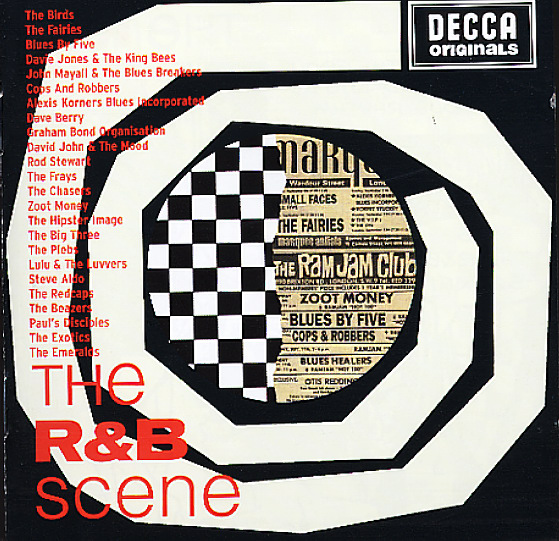
Various Artists 'Decca Originals - R&B Scene'

In case ya couldn't tell, I'm not in the mood for writing, but this is a really great CD. All your favourite mid-60's rhythm 'n blues rockers crammed into one delightful package... In fact much like the 'Decca Girl's Scene' disc, the tracklisting is mostly focused on obscurities - but what obscurities they are!


There's even an appearance from a young, fame-hungry David Jones with his group the King Bees, this is the scene he would later pay tribute to after making it with Ziggy, on the covers album 'Pin-Ups'. There are plenty of other 60s & 70s heroes to be heard here, young, eager and cutting their teeth gigging on the basement circuit... R&B in this context was the harder, blacker alternative to drippy beat pop, and this stuff hasn't really lost any of its power. I daresay most of these groups were London-based, but don't quote me.
Not all these value-for-money Decca retrospectives are absolutely the best in their area, but along with 'Girl's Scene' this is one of the stronger ones. Delivers what it says on the package, chock full of the pill-popping energy of the era... Pretty good for a bunch of skinny English white boys!

Middle class blues

Tuesday, 18 August 2009

BBC Radiophonic Workshop - Music From the BBC Radiophonic Workshop (2003)


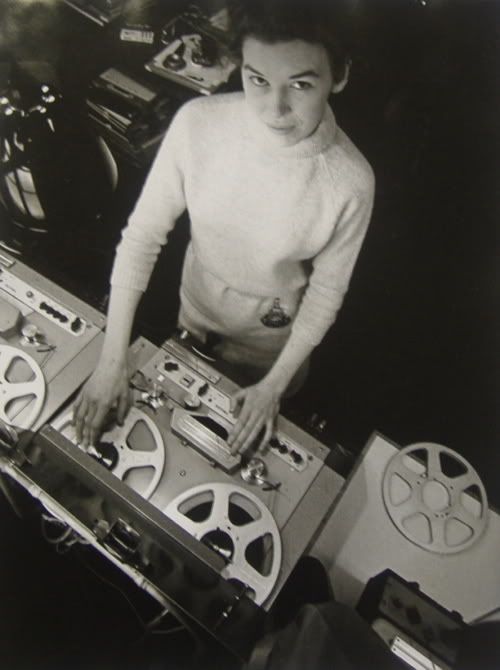
Having compared the subject of my previous post to electronic composer Delia Derbyshire on more than one occasion, I thought it would be good to follow through and let people know just who the hell I was talking about.

The late Ms. Derbyshire was first attached to the BBC's 'Radiophonic Workshop' in the early 60's, along with other drug-free young talent like Brian Hodgson and John Baker. The Workshop was a venture that, over four decades, became the BBC's very own in-house music and sound effects unit; producting for an extensive range of radio and television programming, as well as acting as an alternative to the expensive practive of music licensing.

From it's early days the Workshop was a hotbed for 'budget experimentation' that sought to make soundtracks and create a library of BBC sound effects, without having to hire orchestras and freelance composers. It was a coming together of maths/physics PhDs, BBC jobsworths and hundreds of miles of magnetic tape; the results were some of the most otherwordly and prescient electronic music of the twentieth century.

46 years on, the Workshop's biggest achievement in the public eye still remains the supremely weird proto-techno of the Doctor Who theme, and with good reason. It's hard to believe when you hear it, but this was made before the rise of polyphonic synthesizers (although oscillators are put to good use here); with Derbyshire actually taking Ron Grainer's original composition and realizing it in the manner that would become a signature of the Workshop - manipulating and splicing pieces of analogue tape by hand. The recordings being (literally) cutted & pasted were typically single tones made by instruments or, most commonly, 'found sounds' (bottles, bicycle wheels, anything goes). This approach must have been spurred on by the musique concrete avant-garde of the time... In the 60's at least, the Workshop very much reflects a playful spirit of the age, one that permeated everything from pop music to sound engineering.

The real genius of it though was in the twisted imagination of the music, and the skill these people must have had to build, layer upon layer, highly complex tracks: pulsating bass rhythms overlayed with effects, glitches and washes of sound rendered under such unique conditions as to actually seem extraterrestrial in origin... all with a mathematical precision necessitated by the clumsy, pre-sequencer technology. However the warmth of the analogue sound is more organic and personable; despite the arduous labour that went into making these tracks, generations of British electronica producers will testify that the Workshop was decades ahead of it's time, pre-dating the boom of cerebral, intricate electronica in the 1990's. Just listen to this unprecedented music and imagine - it was all handbuilt from scratch, not cobbled together through some unfathomably complicated monitor interface. At it's best, BBC Radiophonic Workshop was producing the most 'soulful' music you could derive from non-acoustic instruments (without the aid of samplers, which were a long way off).


This limited edition 10'' vinyl box set (compiled, appropriately enough, by Richard D. James' Rephlex label) covers the halcyon days of 1958-75; and by the 70's you can detect the advent of the Moog, also known as Delia's Bane. Not to fear though, because the bar is still set ridiculously high, and the likes of Paddy Kingsland would go on to do amazing work with the Hitchiker's Guide to the Galaxy (listenlistenlisten). Delia and John Baker both get their own discs, and the material runs from inspired bastardizations of radio (apparently a pig-headed British public drew the line at the Radio Sheffield theme); to forerunners for the soundtracks to hellish 80's science videos that some of you might remember from school (parodied perfectly here); to little TV-theme vignettes and beautiful, extended compositions not unlike Derbyshire/Hodgson's seminal electronic-psych masterpiece 'An Electric Storm'.
Mesmerizing, haunting and bloody weird... and it's all thanks to the British taxpayer!

Blue Veils + Golden Sands
Full track details
Comprehesive Delia-worship site

Tuesday, 11 August 2009

Danielle Dax - Comatose Non-Reaction (1990) + "Tomorrow Never Knows" Single (1990)

When I was around 14, I started going through all my parents' albums I hadn't heard before, and Danielle Dax's Dark Adapted Eye (1988 compilation; it finally went back in print in late 2008!) was one that grabbed my attention most. Up to that point, I'd never heard anything quite like that album, with its strange mix of ethnic, often tribal, sounds, the spooky and vaguely psychedelic, and even country-western motifs, showcasing Dax's diverse and impressive vocal and instrumental abilities. Upon investigating whether there was more material, I found that not only was almost everything of hers out of print, but that she's remained incredibly obscure overall (currently with just around 5,000 listeners and, sadly, nothing streamable at Last.fm), which is quite inexplicable, since she has at least the chops of Siouxsie Sioux, more than enough of Kate Bush's quirky madness, and a strong injection of mysticism. I managed to also track down a copy of Blast the Human Flower (1990) a few years ago at Amoeba Records in San Francisco, and scrounged around for her myriad of other releases on the interwebs Apart from the two out-of-print items I'm offering below, her other releases are available via this post at j's heaven [for Jesus Egg That Wept (1984), Blast the Human Flower, and Inky Bloaters (1987)], *here* for Dark Adapted Eye (particularly recommended!) *here* for the Timber Tongue EP (1995; the title track includes a sample from Faust's "Just a Second (Starts Like That)"!) and *here* for Pop-Eyes (1983; this was her first release, entirely self-made and produced).

Prior to her solo endeavors, she was half of the bizarre experimental group Lemon Kittens (see also 1980 EP Cake Beast, also two additional EPs are at mysteryposter), with other half Karl Blake going on to form the Shock Headed Peters and later returning to collaborate with Dax again. Her last solo output was the aforementioned Timber Tongue EP all the way back in 1995, though she collaborated with the equally odd Andrew Liles on his 2008 album Ouarda (The Subtle Art of Phyllorhodomancy) on a few tracks. Apart from being featured on several of Sire's Just Say Yes compilations and apparently permanent cult status, Dax has gotten far less respect than what she deserves for her innovative, and incredibly still-unique works of musical artistry- now's your chance to get in on the secret!

The appropriately-titled Comatose Non-Reaction: The Thwarted Pop Career of Danielle Dax collects some of her singles and notable songs, as well as some tracks unavailable on any other collection, and serves as a good introduction:
Comatose Non-Reaction - Disc 1
- Disc 2
---
Her cover of The Beatles' "Tomorrow Never Knows" is featured on her '90 album Blast the Human Flower, and the single includes both the single and album mixes, "King Crack", and two otherwise unavailable remixes:
Tomorrow Never Knows (Single)

The music video for the track is below:

Friday, 31 July 2009

Blur - B-Sides (1990-'99)


^ Best song they ever did, period...

First off, this has nothing to do with the group's chequebook-balancing reunion - something I really couldn't care less about. It's a measured selection of 20 of the best B-sides and non-album tracks, including 2003's white label 'Don't Bomb If You're the Bomb'. Gloss over that though, because the meat of this is focused on the good stuff - offcuts from the Modern Life Is Rubbish era (possibly the last choking plea for sanity from indie rock Britain produced) which particularly draw attention to the influence of a little band called Wire.
Blur's initial submission to their label Food for their sophomore album was rejected for being too weird, so of course it has some of the best songs. They often suffer from the B-side syndrome of great ideas laboriously stretched out to song length, but what else did you expect? This includes most of (but not all) of the much-revered 'Popscene' EP. It's garnered mostly from the box set of their singles released in 1999, and if there are any particularly impassioned requests for the rest of it I'd be up to fulfilling them.

Unfortunately I was only born in time to see them touring the portentous Think Tank in 2003. What a fucking jip.

modern life is sadistic water torture


^Or was it this?

Thursday, 23 July 2009

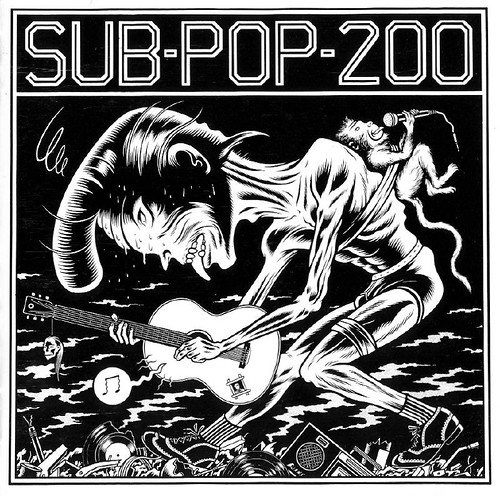
V/A - Sub Pop 200 (1988)

^ Monkey? Back? Geddit?

Apparently in the 80's some American people started a label as a launch pad for this thing called 'grunge' that sounds a bit like punk and a bit like metal, whilst not quite settling for either. I never understood all the hoo-hah myself... I lie of course, early grunge is a wondrous, marvellous thing, second only to a testosterone drip.

Sub Pop 200 is the second label sampler from, er, Sub Pop. Still one of the most successful independents to this day (one might argue that's down to major-label distribution deals but this is beside the point), the music may have broadened out a bit and calmed down for the most part, but there are still some great bands on their roster, the Flipper-meets-Jesus Lizard antics of Pissed Jeans being a favourite.
Here's the list.

This compilation though, is a five-star snapshot of the times, capturing the nascent Seattle grunge scene when it was still a homegrown explosion of scuzzy distortion, tattered jeans and plaid. No international unit-shifters here in 1988, no copycat, watered-down nonsense, and a fair few surprises.


^ Great fat blokes in rock & roll - how many can you name?

For the most part you get hot and heavy, revved-up, slowed-down hardcore mixed with 70's hard rock theatrics; but look out for an acid-munching wall of FX from Screaming Trees, lo-fi college radio stalwarts Beat Happening with easily their least annoying song (a Suicide-esque dirge), the tedious spoken word of Steven J. Bernstein and the de-tuned home recording of the Thrown Ups (great track).
The best thing about Sub Pop 200 though is not just the quality of the obscure bands, but also the total absence of sheen that would characterize the later albums of the more successful groups, bar the obvious exceptions. I guess in 1988 they were still young, filthy and hungry... that's certainly how it sounds.
Oh, and almost all of these songs are exclusive to the compilation. Whatever happened to the fine tradition of the label sampler? Cracking semi-relevant article here.

So, Sub Pop 200 - yet another reason to thank our lucky stars that Black Flag decided to grow their hair...?

Fat
Corporate
Cigar
@320 + art