Wednesday, 9 September 2009

One Last Wish '1986' (1986)


^(Sound quality of video is not representative of album)

People really have some half-arsed ways of categorising music, not to mention marginalising themselves and others. One Last Wish formed in a great year for music, er, 1986, after the dissolution of what many consider to be the first 'emo' band, Rites of Spring. This is still a term I have difficulty acknowledging in the musical sense, not least because it has been lumbered with derogatory connotations and passed into lazy slang for people who don't understand it's true origin... Although by now it's safe to say that the term has been firmly reinvented by morons (after all, what isn't 'emotional'?!) - 'melodramatic' would be so much more apt.
Anyway, when I was still at school, 'emo' was not in use and it didn't constitute a lucrative youth trend - these people were simply labelled as 'goth', a proud label indeed that is, importantly, rooted in a hugely diverse set of musical traditions stretching way back to the late 70's. I try and fail to ignore the developments of pop-metal. What you are getting here is not the Billboard 100 emo that you have come to love or loathe.
If 'emo' must be used, let us use it properly. It was invented as a title for Rites of Spring and their ilk - bands that arose from the always-active Washington, D.C. scene during the Revolution Summer - and who were tentatively billed as 'emotional hardcore' or 'emocore' (which itself has a totally different meaning nowadays). Ian McKaye and his post-hardcore group Fugazi are two of the central pillars of this scene that the music fan 'on the street' will be familiar with; and '1986' is one of the lesser-known classics of McKaye's groundbreaking Dischord label.

One Last Wish comprised of three ex-members of Rites, including singer/guitarist Guy Picciotto. They released only the one short 'n sweet masterpiece before moving on (two of them to Fugazi); and it's a record which I consider to be much superior to the output of their first band, even if they are more celebrated. Every song is a gem, the impassioned delivery is every bit deserving of the original 'emo-core' tag; and it's musically ingenious to boot, more complex and cavernous-sounding than than its violent hardcore brothers. Every little time change within the punk-length songs is calculated to twist the stomach and Picciotto's voice suits the material to a T. It's never a cakewalk understanding rock lyrics at the best of times, but you know the score here: pious straight edge personal politics and good old alienation, both from the mainstream and the 'punk scene'.

Meat is, like, murder

Various Artists 'Sushi 3003' (1996) & Sushi 4004 (1998)

Subtitled 'A Spectacular Collection of Japanese Clubpop' and 'the Return of Spectacular Japanese Clubpop' respectively.
These are the original shibuya-kei introductory compilations unleashed on an unsuspecting world (at least the portion that had never heard Pizzicato Five) through German label Bungalow. In keeping with the spirit of some recent posts, shibuya-kei happens to be a Japanese brand of international pop, a melting pot of many ingredients with the defining featuress being:
An electronica/hip-hop influence, a 60's hipster aesthetic (song titles like 'Bond Street'), twee indie-popness (thanks to the Monochrome Set and Would-Be-Goods in particular) and a heavy dose of the difficult-to-categorise Serge Gainsbourg... French pop, lounge jazz and bossa nova. It's tough to narrow down, but the end result is eclectic enough to keep you guessing from track to track before the glorious masterplan becomes apparent.

Shibuya-kei
simply means 'Shibuya style', Shibuya being the trendy district of Tokyo in which the music first gained popularity in the mid-late 90s. Since then shibuya-kei has covertly infiltrated games, anime and Western movies, gained a few fans along the way (Pizzicato Five and Cornelius are only 'stars' you might recognize on here), and eventually dissipated as a coherent club-oriented genre. Its legacy endures in Nippon since being absorbed into modern J-pop, and elsewhere with the likes of the Yoo-Kayz Momus.

Hardly any of these artists embraced this tag at the time anyway, making shibuya-kei seem all the more like a fortunate accident. Also, Soft Machine fans will not believe their ears when they hear the Kahimi Karie's 'Good Morning World' on 3003. Ees craytsee.
My personal favourite of the two is 4004, the first two tracks of which are in the first upload becausetherewasn'tanyrooooom... Incidentally, Cornelius was previously in the lubly Madchester-influenced band Flipper's Guitar (see post before last), so as usual everything is connected.

Very cool 'Legacy of Shibuya-kei' articles (links are in post @ top of page)
Shibuya-kei on Last.fm

Tuesday, 8 September 2009

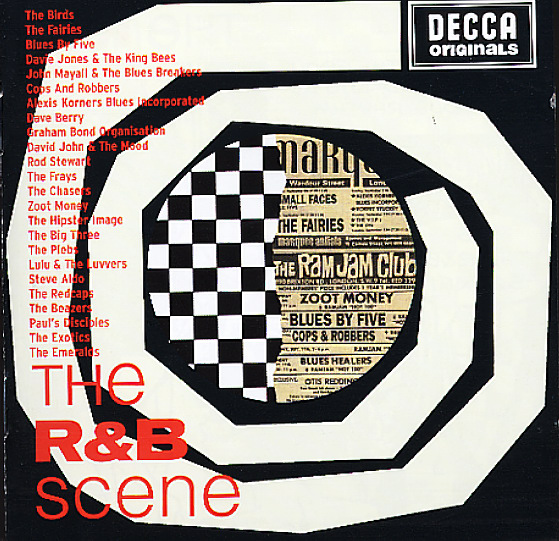
Various Artists 'Decca Originals - R&B Scene'

In case ya couldn't tell, I'm not in the mood for writing, but this is a really great CD. All your favourite mid-60's rhythm 'n blues rockers crammed into one delightful package... In fact much like the 'Decca Girl's Scene' disc, the tracklisting is mostly focused on obscurities - but what obscurities they are!


There's even an appearance from a young, fame-hungry David Jones with his group the King Bees, this is the scene he would later pay tribute to after making it with Ziggy, on the covers album 'Pin-Ups'. There are plenty of other 60s & 70s heroes to be heard here, young, eager and cutting their teeth gigging on the basement circuit... R&B in this context was the harder, blacker alternative to drippy beat pop, and this stuff hasn't really lost any of its power. I daresay most of these groups were London-based, but don't quote me.
Not all these value-for-money Decca retrospectives are absolutely the best in their area, but along with 'Girl's Scene' this is one of the stronger ones. Delivers what it says on the package, chock full of the pill-popping energy of the era... Pretty good for a bunch of skinny English white boys!

Middle class blues

Métal Urbain 'Anarchy In Paris!' (2004)

Just read this now: http://en.wikipedia.org/wiki/M%C3%A9tal_Urbain
Download this compilation that shits from a great height on all your favourite rosbif/scenester/constipated grunters of decades past: http://tiny.cc/Jyw7f

Wednesday, 2 September 2009

Henry Rollins 'Big Ugly Mouth' (1987)

Early, occasionally stuttered recordings of Hank's early spoken word gigs. Rollins (that's pronounced 'raw'-lins, if you're American I guess) is in convivial mood, which will be disarming to anybody who is only familiar with his music with Black Flag, which split up a year before this was released. These spoken word tours proved a hit; he honed the formula of anecdote, opinion, humour and observation and to my understanding still tours relentlessly, to the joy of a devoted cult following. This early gig is a bit rougher around the edges than the later stuff, both in terms of audio quality and delivery, but any fans of Black Flag and a nice dose of realism should enjoy. Rollins would have been 26 here and his frank (sometimes overtly so, like Bill Hicks' 'Goat Boy' schtick), passive-aggressive, self-deprecating, social reject thing has always been very sympathetic and helped me through some hard
times... it helps that he's funny too. He may have matured in the last 15 years, but I miss the angst.
On this rip audio quality seriously dips off in places, but it's comprehensible and you won't be finding it anywhere else online, unless you buy it on sale =P
Great nostalgia factor, slap bang in the middle of Underground America on the campus circuit, complete with dated 80's references, good stuff. http://www.mediafire.com/?zmotzq2yzll


Ryuichi Sakamoto 'The Sheltering Sky' OST (1990)


''The Sheltering Sky is a 1949 novel by Paul Bowles. The story centers on Port and Kit Moresby, a married couple originally from New York who travel to the North African desert accompanied by their friend Tunner. The journey, initially an attempt by Port and Kit to resolve their marital difficulties, is quickly made fraught by the travelers' ignorance of the dangers that surround them. Time magazine included the novel in its 'TIME 100 Best English-language Novels from 1923 to 2005'.''

This is eminent maestro Ryuichi Sakamoto's soundtrack for the 1990 film adaptation starring John 'John' Malkovich. I've never seen this movie, so it's says something for the power of the music that I can enjoy the soundtrack without having any nostalgic connection to the images - it stands on it's own. In truth Sakamoto's orchestral score takes up about about two thirds of the album, the rest is Arabic music (traditional or otherwise), old swing, vintage French chanson - all stuff relevant to the film's setting and a perfect complement to the record. There are two so-so tracks by producer/arranger Richard Horowitz which are literally background music (albeit with some interesting field recordings of Morrocan women's voices from the 50's thrown in).

The meat of the record is of course in Sakamoto's compositions, which are amongst the best he's ever pulled off with an orchestra. One thing it's important to remember is that he has always had parallel careers - one as a modern classical composer and arranger of film scores, the other as a progressive electronic artist with an international bent -and he's somehow nary put a foot wrong in either field. This is quite an accomplishment considering ol' Sakky's been averaging, at least, an album a year since 1978.
So 'The Sheltering Sky' theme is all well and good, grandiose and sweeping as any of the great main themes of cinema, but it's the variations and expressive pieces within the score that are fascinating. Given what is (apparently) the content of the film it's hardly surprising that the music is by turns sorrowful and tender, dark and disturbing. The London Symphony never mucks about (nor should they with their union rates) and they realise the impressionistic Sakamoto score here beautifully. A couple of characteristic Sakamoto piano solos crop up too, this rendition of 'the Sheltering Sky' being one of his classic pieces.
On the whole then: the two 'sides' of the album - one romantic, the other an ethic pick n' mix - present an emotional spectrum you don't find on record all that often.
Get this is you are a soundtrack aficionado, a Sakamoto fan or if you are just looking for something out of the ordinary... In which case the first two conditions will soon apply to you.
D/L

Brian Eno & David Byrne 'My Life In the Bush of Ghosts' (1981)


''My Life in the Bush of Ghosts
is a novel by African writer Amos Tutuola from Nigeria published in 1954. This novel recounts the fate of mortals who stray into the world of ghosts. The 'bush' is in the heart of the tropical forest, an impenetrable thicket left even after the rest of the forest is cleared for cultivation. Here, as every hunter and traveler knows, mortals venture at great peril, and it is here that a small boy is left alone.''

This album, from the very definition of a dynamic duo, is instantly recognisable as being in a genre all it's own, like 'Entroducing...' 25 years before the fact and accomplished not with samplers, but with simple manipulation of the raw tape; from Eno's recordings of radio call-in shows, evangelists, and the various Arabic samples that help to give the album it's haunting quality. Despite an underlying funkiness adeptly provided by Byrne playing most of the instruments (underrated musician that he be), this is a different beast to Byrne & Eno's work on the previous 3 Talking Heads albums.

The fascination with African polyrhythms remains, but as a listening experience it it free of associations with the oeuvre of either artist. The album takes on a life of it's own through the strange grooves characterized by found objects and African percussion, overlayed with those voices from disparate places in languages we can't understand - everything is out of context and the effect is supernatural and, like I said, unique. I've always loved this record and the only thing that comes close (despite all the claims of inspiration by other musicians down the years) is David Byrne's mostly-instrumental 1981 album 'the Catherine Wheel'. Innovative? Probably, 'My Life...' was obscenely ahead of it's time... but nobody went on to imitate the hands-on analogue sampling technique of this album (understandable given the headache it must have been without MIDI). Perhaps that's why sampled-based albums have rarely been so otherwordly? Having said that this would make good rush hour listening; it captures the cold and hollow functionality of an overpopulated urban area whilst being tethered to a sombre spiritual ancestry.

This is the 11-track CD edition (not the whopping 2006 reissue, but you are welcome to buy it for me =P), it's bloody marvellous and of course doesn't include the long-gone but fitting track 'Qu'ran'. The Islamic Council of Great Britain wasn't having a track that sampled readings of the Holy Book, and who were these two nerds to argue? It was struck from the running order, replaced with the B-side 'Very, Very Hungry' and has remained absent from all subsequent reissues. However you can hear it by clicking the link a couple of sentences back.

Here is the extremely cool official website of the album. The samples Eno originally used have all been made public domain so you can download them and do your own mixes. There are also streamable tracks and essays by Byrne about the production of the album and it's connection to the Tutuola book.
And for shits n' giggles here's David Byrne's web-o-log, which is surprisingly good reading... and he doesn't even have to upload any albums?!